
Tag: AI business solutions

  • McDonald’s AI “McHire” platform was breached, allowing for the potential exposure of 64 million applicants private data

    McDonald’s AI “McHire” platform was breached, allowing for the potential exposure of 64 million applicants private data

    For employers, sorting through applications is ordinarily a tedious but necessary part of the hiring process. Enter AI, with artificial intelligence employers can now have AI tools sort candidates based on specific prompt criteria, shortening the time it takes to sort through dozens or even hundreds of applications and propelling the most worthy candidates to the top of the list for human review.

    Or at least, that was the idea. However recently for McDonald’s that idea backfired with a simple mistake, a security flaw in their AI hiring platform dubbed “McHire” or McHire.com allowed attackers to access the logs of any user in the system simply by using the account and username “123456”.

    This allowed access to an administrator account for Paradox.ai, the vendor behind the creation of the McDonald’s AI hiring platform, and the ability to query “Olivia”. Olivia is is the chatbot potential applicants would chat with as they submitted their application.

    The data they were able to access included applicants’ names, emails, addresses and phone numbers. In total there were 64 million records accessible in the system at the time the breach occurred.

    Luckily, the security flaw was discovered by researchers instead of true bad actors. The breakdown of how it was discovered can be found on the blog by security researchers Ian Carroll and Sam Curry. We have reported on their research before when they discovered a major flaw with Kia and other car brand manufacturers allowing for remote access to vehicles (even while they’re actively being driven).

    It’s a sharp reminder that just because AI solutions may make things easier, doesn’t mean that best practices are automatically being followed. The human review is still an important component when deploying any system that will gather large amounts of PII (Personally Identifiable Information) and it’s important to know the rules and restrictions you must follow when collecting that data for your business.

    Below are three rules we recommend following when collecting PII in your business:

    1. Collect Only What’s Necessary (Data Minimization)

    Only gather the PII that is absolutely essential for the purpose at hand. Avoid collecting excess or sensitive data unless it is required. This reduces risk in the event of a data breach and shows respect for user privacy.

    1. Clearly Inform and Obtain Consent

    Be transparent about what data is being collected, why it’s needed, how it will be used, and with whom it might be shared. Always obtain informed consent before collecting any PII, especially for sensitive data like health, financial, or biometric information.

    1. Protect the Data with Strong Security Measures

    Use up-to-date encryption, access controls, and secure storage practices to protect PII from unauthorized access, loss, or misuse. Regularly audit systems and train employees on proper data handling procedures.

    These rules not only build trust with users but also help ensure compliance with regulations like GDPR, CCPA, HIPAA, CMMC and more. If compliance or data protection is a concern for your business, Valley Techlogic can be your go-to partner in creating secure data collection and safeguarding practices alongside deploying industry leading cyber security preventions within your business. Reach out today to learn more.

    Looking for more to read? We suggest these other articles from our site.

    This article was powered by Valley Techlogic, leading provider of trouble free IT services for businesses in California including Merced, Fresno, Stockton & More. You can find more information at https://www.valleytechlogic.com/ or on Facebook at https://www.facebook.com/valleytechlogic/ . Follow us on X at https://x.com/valleytechlogic and LinkedIn at https://www.linkedin.com/company/valley-techlogic-inc/.


  • 6 AI Do’s and Don’t’s Including ways you may be jeopardizing your workplace data with your AI use (and how to avoid)

    6 AI Do’s and Don’t’s Including ways you may be jeopardizing your workplace data with your AI use (and how to avoid)

    AI or Artificial Intelligence is becoming more and more common place in our daily lives, including in our places of work. You may even be using it daily without realizing it, most search engines for example have an AI response to queries baked in at the top of the page and if that’s the farthest you look then all of your searches are currently being powered by AI.

    Other tools like weather apps, navigation and even the spam filter in your inbox is using AI to train and collect data that is then given back to you as answers to your questions or provide solutions you are looking for. Drive a Tesla? All of your driving data is collected and used to train their autonomous car algorithms.

    Which brings us to the topic of today’s article, AI in general is powered by give and take. The models collect our data and turn that data into answers, it’s a common misconception that AI is producing the answers all by itself. Machine learning operates on a rule of 10, basically for every query you need 10 ways to respond, and those responses are collected by unfathomable amounts of data fed into it. Think of the breadth of knowledge an AI program like ChatGPT seems to have and you can begin to see that it would take a lot of data for it to provide to answers to millions of different questions it’s asked each day.

    So that data comes from you, and me, and everyone who’s ever interacted on the internet in a meaningful way. It’s not necessarily a bad thing, after all humanity tends to accomplish its greatest achievements when we all work in unison towards a goal. Although the way that the data is collected and how to approach things like copyright are still being determined.

    So, with all that said you might be wondering, what’s the problem? What should I be worried about when using AI in my workplace? As a technology company, we believe in using the tools available to streamline and strengthen our productivity, but we have determined that companies should be aware of these three things when using a burgeoning technology like AI in their workplace:

    1. Data Risks: As we hinted at above, AI systems tend to syphon as much information as they can to strengthen their machine learning algorithms. This includes potentially sensitive data. Any AI strategy should include how to protect and segment data you don’t want leaked to the outside world.
    2. Errors and Reliability: There are risks to trusting AI completely when looking for answers, AI data sets are fed by a wide range of sources and not all of them are trustworthy. You should always vet any answers you receive, especially if the question you’re asking is an important one.
    3. Bias, Discrimination and Transparency: Most of the AI tools currently on the market are being created by private companies and the processes used are hidden from outside view, so we should keep in mind that it’s possible the answers we’re receiving have been manipulated to reflect a certain outcome. Again, always vet the answers you receive from AI.

    Now that we’ve touched on the things to look out for, what are three things that you can safely use AI for in your workplace?

    1. Use a local AI model: Most people are not aware you can actually have a local in-house AI model, these may be more limited in scope but will not present the security risk of public facing AI and can be built on your own data.
    2. Automating repetitive tasks: Certain tasks won’t carry any risk of data exposure, such as scheduling or creating reports without PII (Personal Identifying Information).
    3. Use it to interact with customers: One of the best use cases of AI currently for businesses is automated chatbots, chatbots can be available 24 hours a day and field simple questions and answers which free up your staff for other activities.

    If you’re looking for the most practical and safest way to begin using AI in your business, Valley Techlogic can help. We are experienced in creating customized technology solutions for our clients and can advise on the way to implement an AI plan that doesn’t compromise on cybersecurity best practices. Reach out today for a consultation.

    Looking for more to read? We suggest these other articles from our site.

    This article was powered by Valley Techlogic, leading provider of trouble free IT services for businesses in California including Merced, Fresno, Stockton & More. You can find more information at https://www.valleytechlogic.com/ or on Facebook at https://www.facebook.com/valleytechlogic/ . Follow us on X at https://x.com/valleytechlogic and LinkedIn at https://www.linkedin.com/company/valley-techlogic-inc/.

  • If AI implementation is important to your business’s 2025 goals, you will want to watch the AI chipset market closely

    If AI implementation is important to your business’s 2025 goals, you will want to watch the AI chipset market closely

    With Project Strawberry (the newest iteration of ChatGPT which is touted to boost it’s reasoning capabilities amongst other new features) on the horizon and more and more businesses taking advantage of AI tools such as Microsoft Co-Pilot and Google Gemini, the AI train doesn’t look like it will be slowing down anytime soon.

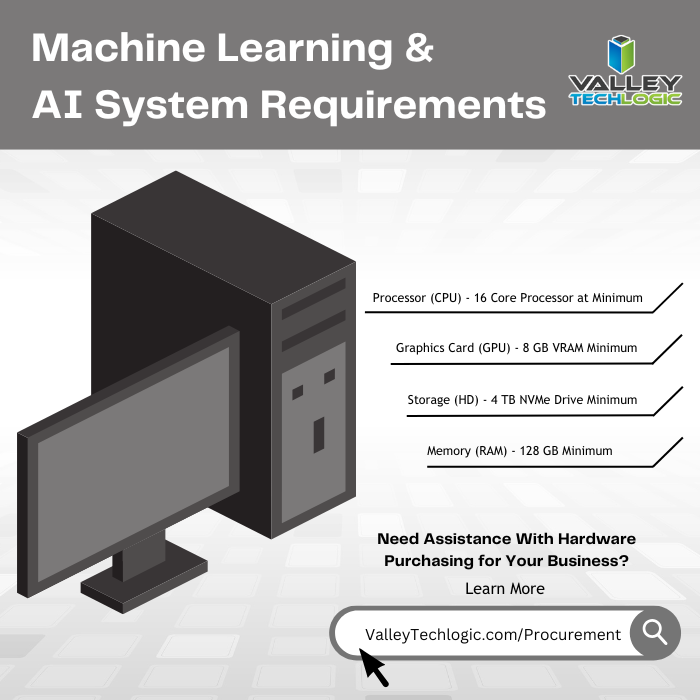
    So, if AI is going to be a priority for your businesses 2025 are you planning on how can you make sure you have devices that can fully take advantage of what AI is capable of? AI workloads can be strenuous on the average machine (see our chart on the minimum specifications we recommend below).

    Why is AI so hardware intensive? AI relies on machine learning to operate, if your computer has to slog through the requests you’re making of it (for example, making presentations, automating tasks and performing searches on your behalf) then that’s going to hinder your ability to use AI to it’s full potential. That may lead to you and your users becoming frustrated and resorting to just returning to prior methods of performing these tasks and stifling the ability to use this emerging innovation in technology.

    Failing to adapt to emerging technologies can be a death knell to many businesses (anyone remember Blockbuster?).

    No one knows more how important keeping up with emerging technologies is than chip makers like Intel, Nvidia and AMD who all have chips set to release next year that will reportedly take full advantage of advancements in AI.

    Nvidia so far has led in this race, with their chips utilizing its own programming language, CUDA (which stands for Compute Unified Device Architecture), which has become standard amongst AI developers. This means they’re dominating this market so far, especially in the data center space. Having direct access to this language from an architecture perspective means that chips made by Nvidia can accelerate processes for AI purposes (thus completing AI tasks more efficiently). Their innovations in the AI space and technology as a whole have led to Nvidia representing 11.7% of the total US GDP.

    AMD hopes to compete with Nvidia and reclaim some of their market share with their new chips, set to be released in early 2025 which will feature their own programing language called ROCm. It’s being said making the switch from CUDA to ROCm will be a painless process and offer more competition in the market (which will only improve things from a cost perspective).

    For example, the current cost of a processor intended for a supercomputer with AMDs new chip set is $14,813 per chip, drastically outside the range of most customers’ comfortable price point for a new device. As competitions and advancements become more common place, we may be getting closer to an age where super computers are not just found in scientific and government settings and there’s no telling how that will change the average workplace in the future.

    There’s also the hardware portion of chip making to consider especially amongst earlier concerns of semiconductors maxing out their capacity for growth and shortages that continued past the height of the pandemic. TSMC also reached a new market share height of over a trillion dollars this week putting fears of that rest for the moment.

    If taking advantage of AI or replacing aging hardware is on your 2025 to-do list, Valley Techlogic can help. We offer tailored advice and procurement assistance as an included feature in our support plans for businesses located in California. Reach out today for more information.

    Looking for more to read? We suggest these other articles from our site.

    This article was powered by Valley Techlogic, leading provider of trouble free IT services for businesses in California including Merced, Fresno, Stockton & More. You can find more information at https://www.valleytechlogic.com/ or on Facebook at https://www.facebook.com/valleytechlogic/ . Follow us on Twitter at https://x.com/valleytechlogic and LinkedIn at https://www.linkedin.com/company/valley-techlogic-inc/.
  • Code named “Strawberry”, OpenAI’s latest update aims to boost reasoning capacity in their AI model

    Code named “Strawberry”, OpenAI’s latest update aims to boost reasoning capacity in their AI model

    Initially labeled Q* for Q Star, Project Strawberry is set to become ChatGPT5 and OpenAI is prepared to launch this update any day now at the time of writing.

    AI competition continues to stiffen up, but many would argue OpenAI has a commanding lead in the AI space with it’s a comparatively more mature model that many believe is more accurate than competitors such as Google’s Gemini and Microsoft’s CoPilot.

    However, as with most AI tools on the market, errors and just general wonkiness are part of the experience and OpenAI and other AI tool providers hope to continue to improve in that arena, providing more accurate results to users without errors and sometimes comical mistakes or “problems” as in the inaccurate word scramble below.

    Hint, no actual words can be spelled with all the letters given.

    OpenAI’s claims Project Strawberry will have “human-like” reasoning skills and answer questions that have stumped the algorithm so far, especially complex math and programming problems.

    This update is also leading up to the larger project for OpenAI, codenamed “Orion” this future tool will be an entirely new AI model and it’s going to be trained entirely via ChatGPT5/Project Strawberry. The hope with using AI to train AI rather than training it via data found online is that we will see a reduction in “AI hallucinations” (or incorrect predictions) and also speed up the rate at which AI can be improved without having to feed it large amounts of online data.

    This would also help OpenAI and other AI competitors avoid the murkier topic of privacy concerns when it comes to where AI is getting it’s data from.

    If you’re considering investing time in AI solutions for your business, we have 4 considerations for you to mull over first (and the first does relate to the data security topic we just mentioned):

    1. Data Security: For most of the AI tools on the market, it’s a known fact that any data you feed into it will also feed into the models they use. We would suggest if you’re considering implementing AI solutions in your business you do so with this factor in mind. Even if a tool claims your data will be secure and not accessible to other users (we’re looking at you CoPilot) AI is still realistically in its infancy. We suggest using an abundance of caution when it comes to data that is proprietary to your business.
    2. Cost (especially Time Cost): AI when used correctly can save your business time and money but using it correctly can be a high barrier to entry. For example, if copy writing is a core facet of your business AI is an excellent tool for sourcing ideas that your team can then spin off into their own creations. If your business is word-of-mouth based cabinetry sales, AI may not be very useful to you at this point in time.
    3. User Experience: Consider the human experience, especially for your customers, when implementing AI solutions. AI chatbots exist but should they replace a real person answering questions on your business’s behalf? Or instead does it make sense to utilize it half way (IE the chatbot answers common questions) with a human representative ready to take over if the questions get more complicated.
    4. AI is not magic: AI will not replace human ingenuity, as outlined above it’s not a perfect solution by any means at this point in time and that’s unlikely to change anytime soon. AI should be used to build upon existing structures in your business (like adding more capacity to your marketing capabilities for example) not with the expectation it’s going to replace those structures entirely.

    Considering implementing AI solutions in your business or hoping to hone in on advancements in technology to your advantage? Valley Techlogic continues to stay at the forefront of new innovations in tech, and we utilize our expertise on behalf of our customers. Reach out today for a consultation.

    Looking for more to read? We suggest these other articles from our site.

    This article was powered by Valley Techlogic, leading provider of trouble free IT services for businesses in California including Merced, Fresno, Stockton & More. You can find more information at https://www.valleytechlogic.com/ or on Facebook at https://www.facebook.com/valleytechlogic/ . Follow us on Twitter at https://x.com/valleytechlogic and LinkedIn at https://www.linkedin.com/company/valley-techlogic-inc/.