
Tag: AI news

  • Are you all in on AI or approaching it more moderately? The perils of not strategizing your AI roll out

    Are you all in on AI or approaching it more moderately? The perils of not strategizing your AI roll out

    AI (Artificial Intelligence) continues to proliferate modern workspaces, with some companies leaning heavily into AI investments including up to replacing human workers with an AI equivalent for roles such as customer service.

    One company, Klarna, is facing some pushback from investors for just such a strategy. Last year, Klarna which is known for it’s “buy now, pay later” financing for consumer purchasing, replaced 700 workers in favor of an AI solution for customer support. Now, their valuation has plummeted from a high of $45.6 billion in 2021 to $6.7 billion in 2025.

    At the heart of it is customer complaints of lower customer service satisfaction which has caused the company to pivot on their “AI First” strategy with their CEO Sebastian Siemiatkowski stating recently “Really investing in the quality of the human support is the way of the future for us.”

    What does this mean for medium and small businesses looking at their own strategizing when it comes to artificial intelligence? Testing the waters and applying it in moderation to start is key to a successful AI roll out.

    While it may seem tempting to just go all in, especially if savings are on the table in terms of labor costs, the current iterations of artificial intelligence are not ready to be deployed without human oversight and intervention in our opinion. Rather than expecting AI to take over and replace human activities, it’s best to look at how you can use AI as a tool to do more.

    Here are three ways we recommend using AI to get the most out of your workday:

    1. Automating Repetitive Tasks
      AI can handle time-consuming activities like data entry, scheduling, and basic customer queries. This frees up employees to focus on higher-value, strategic work that requires human judgment and creativity.
    2. Enhancing Decision-Making
      AI-powered analytics tools can process vast amounts of data quickly and provide actionable insights. This helps employees make faster, more informed decisions without spending hours combing through spreadsheets or reports.
    3. Personalizing Training and Support
      AI can tailor learning experiences to each employee’s role and pace, recommending relevant skills development or providing just-in-time answers through intelligent chatbots. This boosts engagement and accelerates on-the-job learning

    If developing an AI strategy for your business is a priority for you in 2025, Valley Techlogic can help. We make it a priority to stay at the forefront of emerging technologies and help our clients access continuous improvements in the tech space to meet their goals. Reach out today for a consultation.

    Looking for more to read? We suggest these other articles from our site.

    This article was powered by Valley Techlogic, leading provider of trouble free IT services for businesses in California including Merced, Fresno, Stockton & More. You can find more information at https://www.valleytechlogic.com/ or on Facebook at https://www.facebook.com/valleytechlogic/ . Follow us on X at https://x.com/valleytechlogic and LinkedIn at https://www.linkedin.com/company/valley-techlogic-inc/.


  • 6 AI Do’s and Don’t’s Including ways you may be jeopardizing your workplace data with your AI use (and how to avoid)

    6 AI Do’s and Don’t’s Including ways you may be jeopardizing your workplace data with your AI use (and how to avoid)

    AI or Artificial Intelligence is becoming more and more common place in our daily lives, including in our places of work. You may even be using it daily without realizing it, most search engines for example have an AI response to queries baked in at the top of the page and if that’s the farthest you look then all of your searches are currently being powered by AI.

    Other tools like weather apps, navigation and even the spam filter in your inbox is using AI to train and collect data that is then given back to you as answers to your questions or provide solutions you are looking for. Drive a Tesla? All of your driving data is collected and used to train their autonomous car algorithms.

    Which brings us to the topic of today’s article, AI in general is powered by give and take. The models collect our data and turn that data into answers, it’s a common misconception that AI is producing the answers all by itself. Machine learning operates on a rule of 10, basically for every query you need 10 ways to respond, and those responses are collected by unfathomable amounts of data fed into it. Think of the breadth of knowledge an AI program like ChatGPT seems to have and you can begin to see that it would take a lot of data for it to provide to answers to millions of different questions it’s asked each day.

    So that data comes from you, and me, and everyone who’s ever interacted on the internet in a meaningful way. It’s not necessarily a bad thing, after all humanity tends to accomplish its greatest achievements when we all work in unison towards a goal. Although the way that the data is collected and how to approach things like copyright are still being determined.

    So, with all that said you might be wondering, what’s the problem? What should I be worried about when using AI in my workplace? As a technology company, we believe in using the tools available to streamline and strengthen our productivity, but we have determined that companies should be aware of these three things when using a burgeoning technology like AI in their workplace:

    1. Data Risks: As we hinted at above, AI systems tend to syphon as much information as they can to strengthen their machine learning algorithms. This includes potentially sensitive data. Any AI strategy should include how to protect and segment data you don’t want leaked to the outside world.
    2. Errors and Reliability: There are risks to trusting AI completely when looking for answers, AI data sets are fed by a wide range of sources and not all of them are trustworthy. You should always vet any answers you receive, especially if the question you’re asking is an important one.
    3. Bias, Discrimination and Transparency: Most of the AI tools currently on the market are being created by private companies and the processes used are hidden from outside view, so we should keep in mind that it’s possible the answers we’re receiving have been manipulated to reflect a certain outcome. Again, always vet the answers you receive from AI.

    Now that we’ve touched on the things to look out for, what are three things that you can safely use AI for in your workplace?

    1. Use a local AI model: Most people are not aware you can actually have a local in-house AI model, these may be more limited in scope but will not present the security risk of public facing AI and can be built on your own data.
    2. Automating repetitive tasks: Certain tasks won’t carry any risk of data exposure, such as scheduling or creating reports without PII (Personal Identifying Information).
    3. Use it to interact with customers: One of the best use cases of AI currently for businesses is automated chatbots, chatbots can be available 24 hours a day and field simple questions and answers which free up your staff for other activities.

    If you’re looking for the most practical and safest way to begin using AI in your business, Valley Techlogic can help. We are experienced in creating customized technology solutions for our clients and can advise on the way to implement an AI plan that doesn’t compromise on cybersecurity best practices. Reach out today for a consultation.

    Looking for more to read? We suggest these other articles from our site.

    This article was powered by Valley Techlogic, leading provider of trouble free IT services for businesses in California including Merced, Fresno, Stockton & More. You can find more information at https://www.valleytechlogic.com/ or on Facebook at https://www.facebook.com/valleytechlogic/ . Follow us on X at https://x.com/valleytechlogic and LinkedIn at https://www.linkedin.com/company/valley-techlogic-inc/.
  • China enters the AI race with the release of DeepSeek, prompting conversations about what happens when AI tools take data from each other (rather than just the general public)

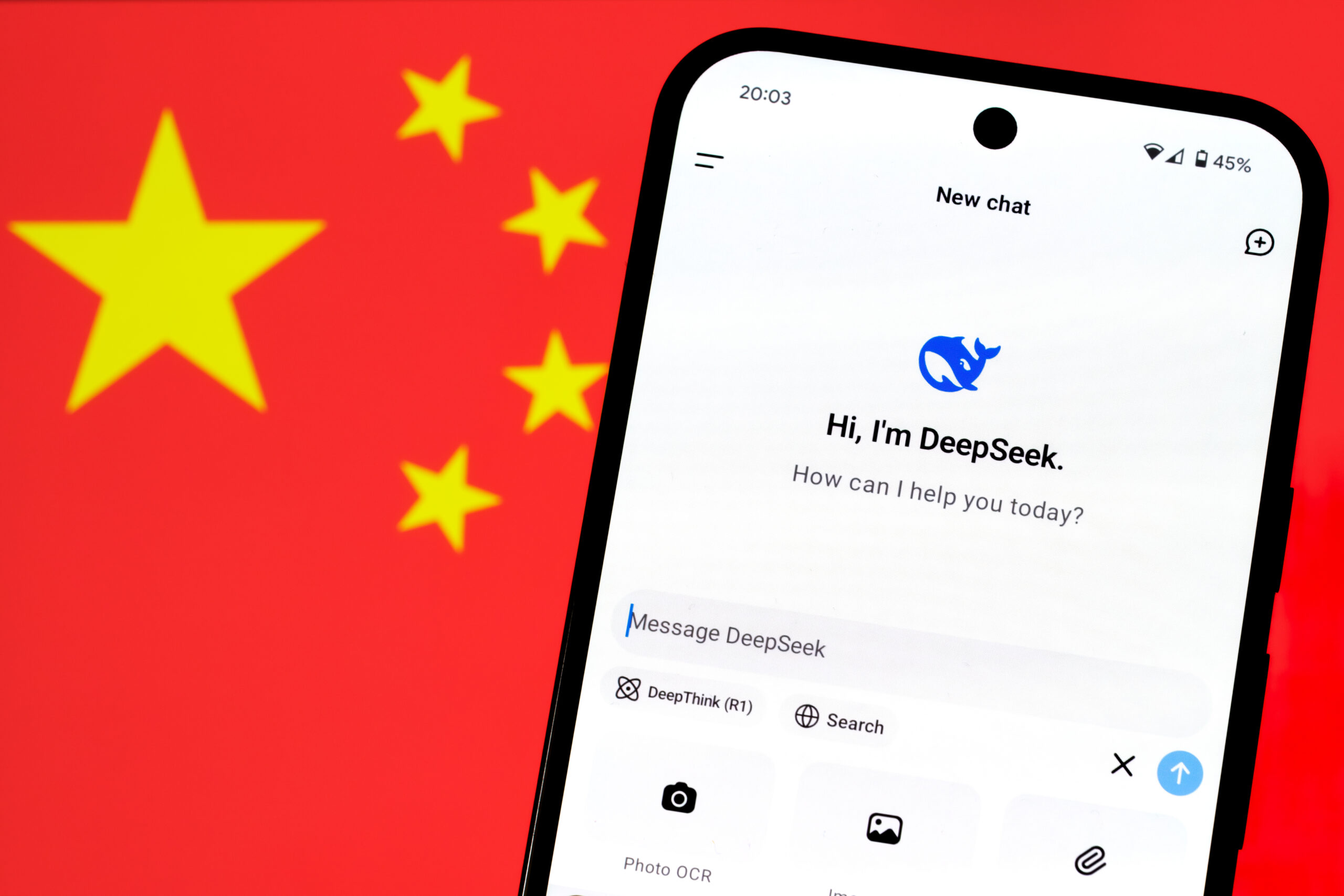
    China enters the AI race with the release of DeepSeek, prompting conversations about what happens when AI tools take data from each other (rather than just the general public)

    The race for domination continues to heat up at China’s AI model “DeepSeek” enters the fray, just days after newly inaugurated President Trump announced his plans to invest 500 billion in AI infrastructure during the course of his term.

    Established as a startup under the same umbrella as the quantitive hedge fund High-Flyer, which is primarily owned by AI enthusiast Liang WenFeng (who built his fortune during the 2007-2008 financial crisis), little has been verified about how DeepSeek came to be.

    That has not stopped endless speculation since it’s launch was announced, including how much of it is modeled after existing AI models such OpenAI’s ubiquitous model, ChatGPT.

    Also being questioned is how the chips it was trained on were sourced, chip restrictions were placed in on China in 2019 which continued under President Biden specifically to curtail China’s ability to access infrastructure used in the advancement of AI technology. This restriction not only covered the chips themselves, but the technology used to manufacture them.

    According to Liang, he sourced the the 10,000 Nvidia A100 GPUs prior to the federally imposed ban.

    At present time the founders of DeepSeek are indicating that their goal is to continue the research and advancement of AI infrastructure with their model and not seek commercialization. To back these claims, you can currently download the first series of their model for free open source whether you’re a researcher or a commercial user.

    It should also be noted that DeepSeek has an updated data set as compared to ChatGPT, which is currently capped to data from 2023, what this means is its most recent data is from 2023 and before and anything that occurred in 2024 and beyond would not be available so if you were to example ask ChatGPT “Who won the 2024 Presidential Election?” it may not give you a correct answer.

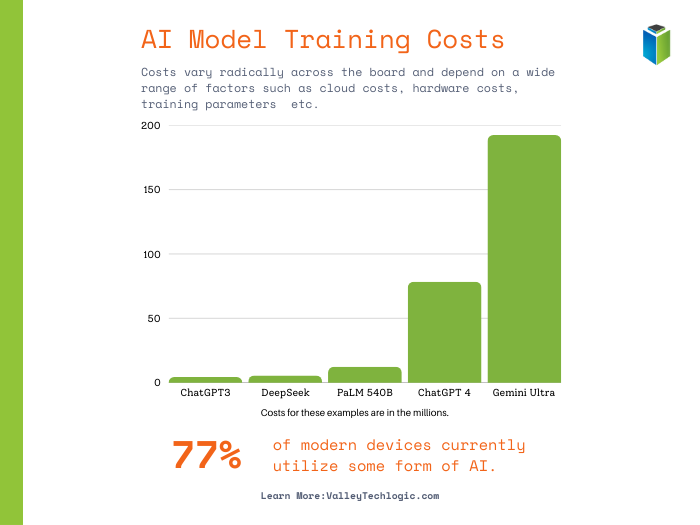
    There have also been claims that DeepSeek is much cheaper to train, although training costs for existing AI models are largely inflated. These costs are based on the cost of cloud computing rental prices, which have a wide range of variance.

    AI training costs vary wildly depending on a range of factors.

    AI and cloud computing are both worthy investments for businesses looking to strategically position themselves for technology growth in 2025 and beyond, and Valley Techlogic is at the forefront of utilizing these technologies.

    Whether it be initializing AI tools like Microsoft’s Co-Pilot in your business or migrating more of your operations to the cloud to reduce overhead spending on physical hardware, we’ve got you covered. Reach out today for a consultation and learn how you can catapult your business forward with technology advancements through Valley Techlogic.

    Looking for more to read? We suggest these other articles from our site.

    This article was powered by Valley Techlogic, leading provider of trouble free IT services for businesses in California including Merced, Fresno, Stockton & More. You can find more information at https://www.valleytechlogic.com/ or on Facebook at https://www.facebook.com/valleytechlogic/ . Follow us on X at https://x.com/valleytechlogic and LinkedIn at https://www.linkedin.com/company/valley-techlogic-inc/.