

Tag: threat prevention

  • Staying secure on the 4th, why phishing attacks increase during holiday weekends

    Staying secure on the 4th, why phishing attacks increase during holiday weekends

    We’ve touched on this topic before, but we thought a reminder as we approach the Fourth of July weekend couldn’t hurt, hackers don’t take the holidays off.

    This includes summer holidays such as Memorial Day and the 4th of July in addition to the typical winter festivities. Bad actors know that the holidays can be a boon for their nefarious activities, employees may be less on guard as they look forward to the extra time off and routines are thrown off with a disruption to the normal M-F patterned workweek.

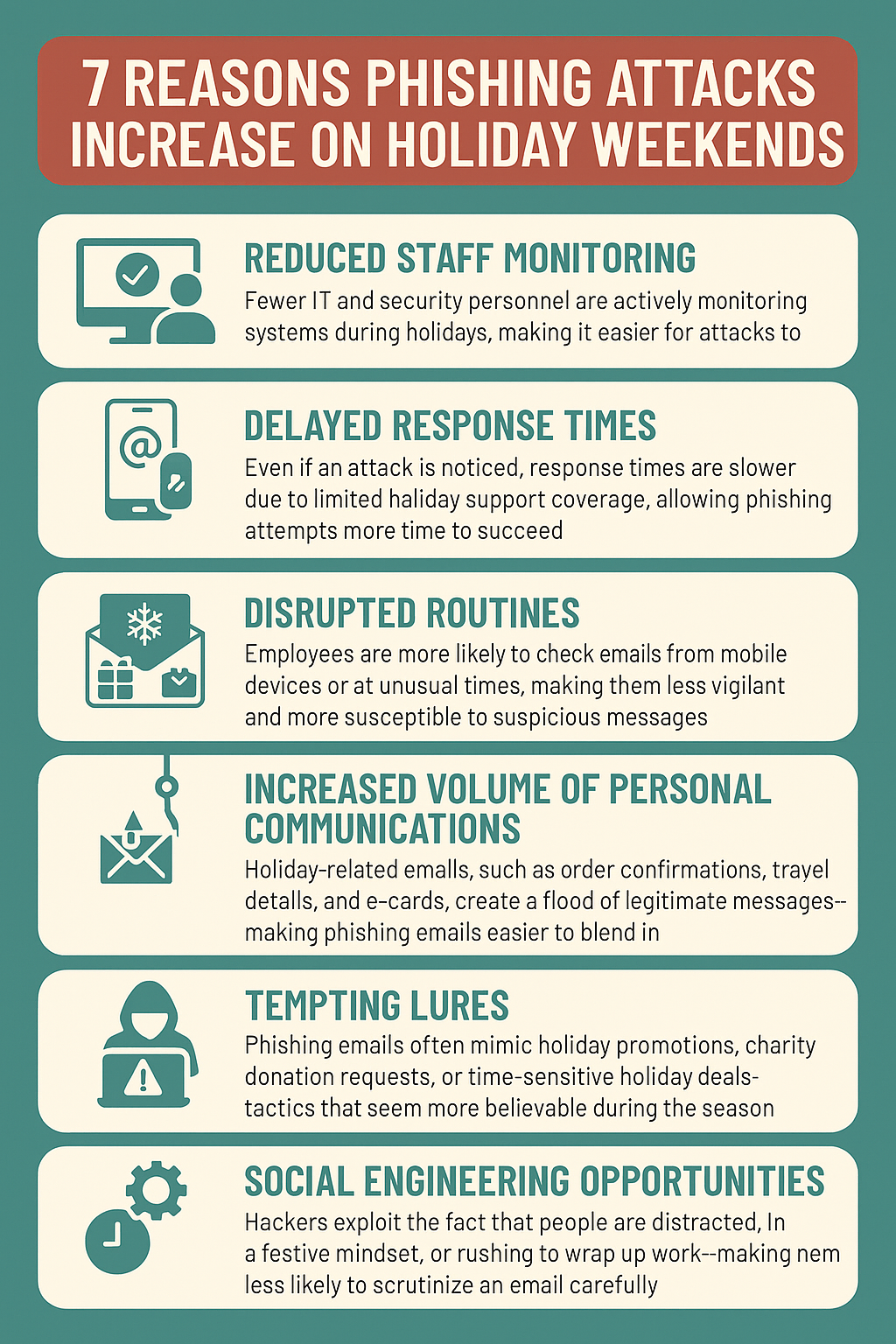
    Here are 7 ways the holidays lead to a higher risk of phishing attacks:

    • Reduced Staff Monitoring
      Fewer IT and security personnel are actively monitoring systems during holidays, making it easier for attacks to go undetected.
    • Delayed Response Times
      Even if an attack is noticed, response times are slower due to limited holiday support coverage, allowing phishing attempts more time to succeed.
    • Disrupted Routines
      Employees are more likely to check emails from mobile devices or at unusual times, making them less vigilant and more susceptible to suspicious messages.
    • Increased Volume of Personal Communications
      Holiday-related emails, such as order confirmations, travel details, and e-cards, create a flood of legitimate messages—making phishing emails easier to blend in.
    • Tempting Lures
      Phishing emails often mimic holiday promotions, charity donation requests, or time-sensitive holiday deals—tactics that seem more believable during the season.
    • Social Engineering Opportunities
      Hackers exploit the fact that people are distracted, in a festive mindset, or rushing to wrap up work—making them less likely to scrutinize an email carefully.
    • Gaps in System Updates
      Routine maintenance and updates might be paused during holidays, leaving systems more vulnerable to phishing-based exploits that rely on unpatched software.

    (Download these tips as an Infographic below.)
    Phishing attacks are one of the most common—and costly—cyber threats facing small businesses today. At Valley Techlogic, we help protect your business by implementing robust email security solutions, conducting employee phishing awareness training, and monitoring for suspicious activity around the clock. Our proactive approach ensures you’re not just reacting to threats but preventing them before they reach your inbox. Reach out today for more information.

    Looking for more to read? We suggest these other articles from our site.

    This article was powered by Valley Techlogic, leading provider of trouble free IT services for businesses in California including Merced, Fresno, Stockton & More. You can find more information at https://www.valleytechlogic.com/ or on Facebook at https://www.facebook.com/valleytechlogic/ . Follow us on X at https://x.com/valleytechlogic and LinkedIn at https://www.linkedin.com/company/valley-techlogic-inc/.


  • Leave the World Behind features alleged cyber warfare as the main movie villain, how realistic was it?

    Leave the World Behind features alleged cyber warfare as the main movie villain, how realistic was it?

    The cyber attacks we typically report on are localized or contained to a specific sector or even business entity.

    In Netflix’s new movie “Leave the World Behind” characters are confronted with what looked like a global cyber attack causing mass destruction and chaos, including self-driving cars crashing into each other with no driver present and planes crashing into the ocean into land with GPS absent.

    The movie features an all-star cast and is the first movie we’ve seen take on the apocalypse narrative with a unique technology twist – not to besmirch the Terminator legacy, but killer robots are found fairly frequently in pop culture.

    Originally adapted from Rumaan Alam’s book of the same name, the movie actually takes liberty in specifically calling out the cyber attack in the movie where in the book the nature of what’s going on is left a lot more ambiguous.

    The movie even received feedback from former President Barack Obama to make sure the cyber warfare elements were realistic instead of fantastic which left us with an eerie feeling after viewing the film, because the truth is some of the elements of it could be replicated in real life.

    Venturing into spoiler territory now, at several points in the movie the characters are subjected to an ear-piercing noise that stops them in their tracks. It’s alluded to that these attacks might be “sonic booms” and are the reason one of the characters begins having physical symptoms as a response (odontophobia folks beware). This attack in the movie mirrored an alleged event in Cuba where directed energy waves, in this case microwave instead of sound, caused physical harm to locals.

    In another scene one of the main characters attempts to check her phone for news and is instead confronted with several news articles, seemingly normal messages at first then devolving on red paper are dropped from a drone in the sky on a character driving down an empty road – this is several hours after the characters have been cut off from the outside world by the technology we all rely on for news and information.

    By sheer coincidence these scenes are again mirrored by a real-life news event that happened just this month, where Iran-located hackers took over a water authority in Pennsylvania because their devices were Iran made, screens of these electronics found in the facility displayed a message in red with “YOU HAVE BEEN HACKED” featured prominently.

    It’s unlikely that an attack could take out an entire nation easily, but it is worrying for us as a technology provider when we encounter lackadaisical responses to very serious cyber threats. The whole world does not need to be hacked for a hack to affect your whole world.

    If after watching this new blockbuster you’re thinking it might be time to evaluate your cyber preparedness, Valley Techlogic has you covered.

    If you book a consultation with us this month you will even receive a $100 cash for your time just for hearing us out. Click here or on the image below to get started.


    Looking for more to read? We suggest these other articles from our site.

    This article was powered by Valley Techlogic, an IT service provider in Atwater, CA. You can find more information at https://www.valleytechlogic.com/ or on Facebook at https://www.facebook.com/valleytechlogic/ . Follow us on Twitter at https://x.com/valleytechlogic.