
Tag: AI advancements

  • An anonymous company accidentally spent 500 million on Claude in one month when it placed no usage limits on employees, and how it relates to your AI strategy as a small business

    An anonymous company accidentally spent 500 million on Claude in one month when it placed no usage limits on employees, and how it relates to your AI strategy as a small business

    A recent report claimed that an anonymous company accidentally spent $500 million on Anthropic’s Claude in a single month after failing to put usage limits on employee access.

    That number is absurd. For most small businesses, it sounds so far removed from reality that it is easy to laugh it off and move on, but that would be the wrong lesson.

    The point is not that your business is going to wake up tomorrow with a half-billion-dollar AI bill. The point is that AI has introduced a new kind of business risk: fast-moving, employee-driven, poorly governed software usage that can create cost, security, compliance, and operational problems before leadership even knows what is happening.

    Small businesses do not need a Fortune 500 AI budget to make Fortune 500 AI mistakes. They just make them at a smaller scale, and sometimes a smaller mistake hurts more because there is less financial room to absorb it.

    AI adoption is moving faster than AI strategy, your employees are already using AI. They are using ChatGPT, Claude, Copilot, Gemini, browser extensions, AI note takers, AI writing tools, coding assistants, image generators, meeting bots, inbox assistants, and whatever else promises to save them time.

    Some of this is good. AI can absolutely improve productivity. It can help write first drafts, summarize documents, review contracts, organize meeting notes, analyze spreadsheets, draft client communications, troubleshoot technical problems, and speed up repetitive work.

    The problem is not AI usage, the problem is unmanaged AI usage.

    Many businesses are still treating AI as a novelty or a personal productivity tool, while employees are already treating it like infrastructure. That gap is where the risk lives.

    If employees are using AI tools without clear rules, approved platforms, data handling guidance, spending controls, and accountability, the business has not adopted AI strategically. It has simply allowed AI to spread.

    That is not a strategy. That is drift. The reported Claude incident is a perfect example of what happens when access is confused with strategy.

    Giving employees access to powerful AI tools can be valuable, but access alone does not answer the most important questions.

    Who is allowed to use the tool?
    What business problems should it be used for?
    What data is allowed to go into it?
    What data is prohibited?
    Who owns the output?
    How is usage monitored?
    How are costs capped?
    How do we measure whether this is actually helping?


    Without answers to those questions, at best AI becomes another unmanaged business expense. At worse, it becomes an unmanaged business process.

    That matters because modern AI tools are not like traditional software subscriptions. A normal SaaS tool usually has a predictable monthly cost per user. AI can be different. Depending on the platform, plan, API model, agentic workflow, integrations, automation, and volume of usage, costs can scale quickly. The more powerful the workflow, the more important governance becomes.

    This is especially true with AI agents and coding assistants. These tools do not just answer one question and stop. They can perform multi-step tasks, generate large amounts of output, run repeated analysis, review codebases, process documents, or interact with other systems. That can be useful, but it also means the cost and risk can grow quietly in the background.

    For a small business, the danger is not a $500 million invoice. The danger is paying for tools no one is managing, letting sensitive data leak into platforms that were never approved, relying on AI-generated work no one reviews, or building business processes around accounts the company does not control.

    Some businesses will hear stories like this and decide the safest move is to block AI entirely. That is understandable, but it is usually not realistic. If AI tools help employees do their jobs faster, people will find ways to use them. If the business does not provide an approved path, employees may create their own path. That is how shadow IT happens. The better approach is not panic, it is governance.

    AI governance does not need to be complicated. For most small businesses, it should start with practical controls that match the size of the company. A good small business AI strategy should include:

    • Approved AI tools and platforms
    • Clear rules for what data can and cannot be entered
    • Spending limits and usage monitoring
    • Role-based access for employees
    • Human review for important AI-generated work
    • Policies for client data, financial data, health data, legal documents, credentials, and confidential information
    • A process for evaluating new AI tools before employees start using them
    • A way to measure whether AI is saving time, improving quality, or reducing cost

    That last point is critical. AI should not be adopted because it is exciting. It should be adopted because it solves a real business problem.

    If an AI tool saves five hours per week, improves response times, helps generate better proposals, reduces administrative work, or improves customer service, that is useful. If it creates more subscriptions, more confusion, more risk, and more low-quality output, it is not innovation. It is clutter.

    Cost control is only one part of the strategy, the Claude story is dramatic because the dollar amount is dramatic. But for small businesses, cost is only one part of the AI risk picture. The bigger issue may be data control. Employees may paste client emails, contracts, tax documents, HR issues, financial records, passwords, source code, internal strategy, vendor disputes, or customer lists into AI tools without realizing the consequences.

    That does not mean every AI platform is unsafe. Some enterprise AI platforms provide stronger privacy, security, and data handling protections than consumer-grade tools. But the business needs to know which tools are being used and under what terms. This is where small businesses need to be honest with themselves. If employees are using free personal AI accounts to process company information, the company probably does not have enough visibility or control.

    That creates real questions.

    1. Where is the data going?
    2. Is it being used for model training?
    3. Can the company audit usage?
    4. Can access be revoked when an employee leaves?
    5. Is multifactor authentication enforced?
    6. Are files being uploaded?
    7. Are browser extensions reading sensitive pages?
    8. Are AI meeting bots recording confidential conversations?

    These are not theoretical concerns. They are the same kinds of basic governance questions businesses already ask about email, file sharing, password managers, CRMs, and accounting systems. AI should be treated with the same seriousness. A small business does not need to start with a grand AI transformation plan. It should start with a simple question: Where can AI safely and measurably improve the business?

    That might mean using AI to draft marketing content, summarize long documents, build internal SOPs, assist with help desk responses, analyze sales data, improve customer communication, or speed up research. Start with real use cases. Then match the tool to the use case. Then apply controls.

    A practical AI rollout might look like this:

    1. Identify the top three repetitive tasks employees spend too much time on.
    2. Choose one approved AI platform for business use.
    3. Define what data is allowed and prohibited.
    4. Set user access, billing limits, and administrative ownership.
    5. Train employees on safe and effective usage.
    6. Review results after 30 to 60 days.

    That is not flashy, but it works. The goal is not to use AI everywhere. The goal is to use AI where it produces value without creating unnecessary risk. AI should be managed like any of your other business systems. The biggest mistake small businesses can make is treating AI as something outside normal IT and business management. It is not.

    AI touches identity, security, compliance, finance, operations, HR, sales, marketing, customer service, and intellectual property. That means it needs ownership. Someone needs to be responsible for deciding which tools are approved, how accounts are managed, how data is protected, how employees are trained, how spending is reviewed, and how the business measures results. For many small businesses, that responsibility should involve leadership, IT, and whoever owns the affected business process.

    For example, marketing should help define AI use in content creation. Finance should care about billing and invoice-related AI usage. HR should care about employee data. IT should care about access, security, logging, and data protection. Leadership should care about the overall business value. AI is too powerful to be left entirely to individual preference.

    The reported $500 million Claude bill is not just a story about one company’s lack of spending controls. It is a warning about what happens when AI adoption outruns AI management. Small businesses should not avoid AI. That would be shortsighted, but they should also not let AI creep into the business through personal accounts, unmanaged tools, unclear policies, and uncapped spending. The right approach is controlled adoption.

    Use AI. Encourage experimentation. Look for productivity gains. But put guardrails in place. Decide which tools are approved. Protect sensitive data. Set spending limits. Train employees. Review usage. Measure outcomes. Keep humans responsible for important decisions. AI can be a real advantage for small businesses, especially the ones willing to use it thoughtfully. But like every powerful tool, it needs rules.

    The companies that get this right will not be the ones that blindly chase every new AI feature. They will be the ones that build AI into their business with discipline, security, and a clear purpose. That is the lesson small businesses should take from the Claude story. AI without strategy is just another unmanaged expense. AI with strategy can become an advantage. At Valley Techlogic, we can be your strategic partner as you roll out AI in your business and help prevent costly mistakes like the one in this article. Learn more today with a consultation.
    Looking for more to read?

    This article was powered by Valley Techlogic, leading provider of trouble free IT services for businesses in California including Merced, Fresno, Stockton & More. You can find more information at https://www.valleytechlogic.com/ or on Facebook at https://www.facebook.com/valleytechlogic/ . Follow us on X at https://x.com/valleytechlogic and LinkedIn at https://www.linkedin.com/company/valley-techlogic-inc/.


  • McDonald’s AI “McHire” platform was breached, allowing for the potential exposure of 64 million applicants private data

    McDonald’s AI “McHire” platform was breached, allowing for the potential exposure of 64 million applicants private data

    For employers, sorting through applications is ordinarily a tedious but necessary part of the hiring process. Enter AI, with artificial intelligence employers can now have AI tools sort candidates based on specific prompt criteria, shortening the time it takes to sort through dozens or even hundreds of applications and propelling the most worthy candidates to the top of the list for human review.

    Or at least, that was the idea. However recently for McDonald’s that idea backfired with a simple mistake, a security flaw in their AI hiring platform dubbed “McHire” or McHire.com allowed attackers to access the logs of any user in the system simply by using the account and username “123456”.

    This allowed access to an administrator account for Paradox.ai, the vendor behind the creation of the McDonald’s AI hiring platform, and the ability to query “Olivia”. Olivia is is the chatbot potential applicants would chat with as they submitted their application.

    The data they were able to access included applicants’ names, emails, addresses and phone numbers. In total there were 64 million records accessible in the system at the time the breach occurred.

    Luckily, the security flaw was discovered by researchers instead of true bad actors. The breakdown of how it was discovered can be found on the blog by security researchers Ian Carroll and Sam Curry. We have reported on their research before when they discovered a major flaw with Kia and other car brand manufacturers allowing for remote access to vehicles (even while they’re actively being driven).

    It’s a sharp reminder that just because AI solutions may make things easier, doesn’t mean that best practices are automatically being followed. The human review is still an important component when deploying any system that will gather large amounts of PII (Personally Identifiable Information) and it’s important to know the rules and restrictions you must follow when collecting that data for your business.

    Below are three rules we recommend following when collecting PII in your business:

    1. Collect Only What’s Necessary (Data Minimization)

    Only gather the PII that is absolutely essential for the purpose at hand. Avoid collecting excess or sensitive data unless it is required. This reduces risk in the event of a data breach and shows respect for user privacy.

    1. Clearly Inform and Obtain Consent

    Be transparent about what data is being collected, why it’s needed, how it will be used, and with whom it might be shared. Always obtain informed consent before collecting any PII, especially for sensitive data like health, financial, or biometric information.

    1. Protect the Data with Strong Security Measures

    Use up-to-date encryption, access controls, and secure storage practices to protect PII from unauthorized access, loss, or misuse. Regularly audit systems and train employees on proper data handling procedures.

    These rules not only build trust with users but also help ensure compliance with regulations like GDPR, CCPA, HIPAA, CMMC and more. If compliance or data protection is a concern for your business, Valley Techlogic can be your go-to partner in creating secure data collection and safeguarding practices alongside deploying industry leading cyber security preventions within your business. Reach out today to learn more.

    Looking for more to read? We suggest these other articles from our site.

    This article was powered by Valley Techlogic, leading provider of trouble free IT services for businesses in California including Merced, Fresno, Stockton & More. You can find more information at https://www.valleytechlogic.com/ or on Facebook at https://www.facebook.com/valleytechlogic/ . Follow us on X at https://x.com/valleytechlogic and LinkedIn at https://www.linkedin.com/company/valley-techlogic-inc/.

  • Are you all in on AI or approaching it more moderately? The perils of not strategizing your AI roll out

    Are you all in on AI or approaching it more moderately? The perils of not strategizing your AI roll out

    AI (Artificial Intelligence) continues to proliferate modern workspaces, with some companies leaning heavily into AI investments including up to replacing human workers with an AI equivalent for roles such as customer service.

    One company, Klarna, is facing some pushback from investors for just such a strategy. Last year, Klarna which is known for it’s “buy now, pay later” financing for consumer purchasing, replaced 700 workers in favor of an AI solution for customer support. Now, their valuation has plummeted from a high of $45.6 billion in 2021 to $6.7 billion in 2025.

    At the heart of it is customer complaints of lower customer service satisfaction which has caused the company to pivot on their “AI First” strategy with their CEO Sebastian Siemiatkowski stating recently “Really investing in the quality of the human support is the way of the future for us.”

    What does this mean for medium and small businesses looking at their own strategizing when it comes to artificial intelligence? Testing the waters and applying it in moderation to start is key to a successful AI roll out.

    While it may seem tempting to just go all in, especially if savings are on the table in terms of labor costs, the current iterations of artificial intelligence are not ready to be deployed without human oversight and intervention in our opinion. Rather than expecting AI to take over and replace human activities, it’s best to look at how you can use AI as a tool to do more.

    Here are three ways we recommend using AI to get the most out of your workday:

    1. Automating Repetitive Tasks
      AI can handle time-consuming activities like data entry, scheduling, and basic customer queries. This frees up employees to focus on higher-value, strategic work that requires human judgment and creativity.
    2. Enhancing Decision-Making
      AI-powered analytics tools can process vast amounts of data quickly and provide actionable insights. This helps employees make faster, more informed decisions without spending hours combing through spreadsheets or reports.
    3. Personalizing Training and Support
      AI can tailor learning experiences to each employee’s role and pace, recommending relevant skills development or providing just-in-time answers through intelligent chatbots. This boosts engagement and accelerates on-the-job learning

    If developing an AI strategy for your business is a priority for you in 2025, Valley Techlogic can help. We make it a priority to stay at the forefront of emerging technologies and help our clients access continuous improvements in the tech space to meet their goals. Reach out today for a consultation.

    Looking for more to read? We suggest these other articles from our site.

    This article was powered by Valley Techlogic, leading provider of trouble free IT services for businesses in California including Merced, Fresno, Stockton & More. You can find more information at https://www.valleytechlogic.com/ or on Facebook at https://www.facebook.com/valleytechlogic/ . Follow us on X at https://x.com/valleytechlogic and LinkedIn at https://www.linkedin.com/company/valley-techlogic-inc/.

  • China enters the AI race with the release of DeepSeek, prompting conversations about what happens when AI tools take data from each other (rather than just the general public)

    China enters the AI race with the release of DeepSeek, prompting conversations about what happens when AI tools take data from each other (rather than just the general public)

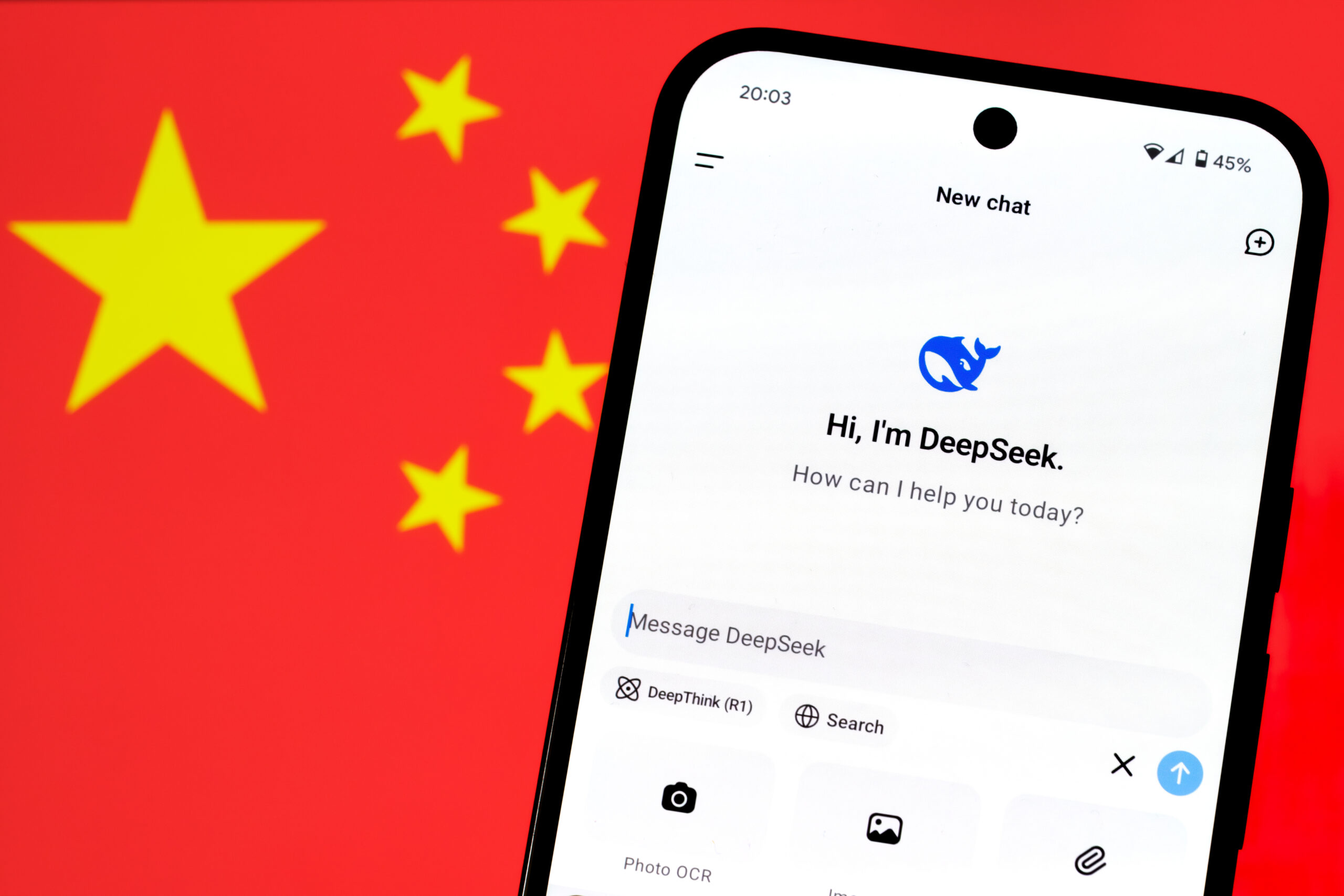
    The race for domination continues to heat up at China’s AI model “DeepSeek” enters the fray, just days after newly inaugurated President Trump announced his plans to invest 500 billion in AI infrastructure during the course of his term.

    Established as a startup under the same umbrella as the quantitive hedge fund High-Flyer, which is primarily owned by AI enthusiast Liang WenFeng (who built his fortune during the 2007-2008 financial crisis), little has been verified about how DeepSeek came to be.

    That has not stopped endless speculation since it’s launch was announced, including how much of it is modeled after existing AI models such OpenAI’s ubiquitous model, ChatGPT.

    Also being questioned is how the chips it was trained on were sourced, chip restrictions were placed in on China in 2019 which continued under President Biden specifically to curtail China’s ability to access infrastructure used in the advancement of AI technology. This restriction not only covered the chips themselves, but the technology used to manufacture them.

    According to Liang, he sourced the the 10,000 Nvidia A100 GPUs prior to the federally imposed ban.

    At present time the founders of DeepSeek are indicating that their goal is to continue the research and advancement of AI infrastructure with their model and not seek commercialization. To back these claims, you can currently download the first series of their model for free open source whether you’re a researcher or a commercial user.

    It should also be noted that DeepSeek has an updated data set as compared to ChatGPT, which is currently capped to data from 2023, what this means is its most recent data is from 2023 and before and anything that occurred in 2024 and beyond would not be available so if you were to example ask ChatGPT “Who won the 2024 Presidential Election?” it may not give you a correct answer.

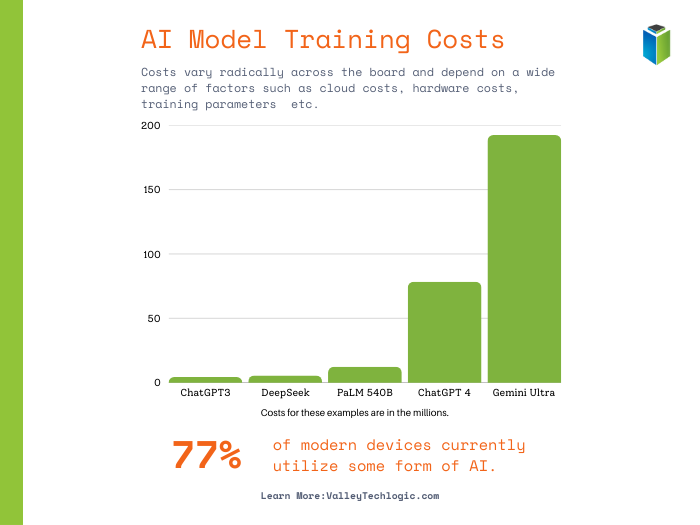
    There have also been claims that DeepSeek is much cheaper to train, although training costs for existing AI models are largely inflated. These costs are based on the cost of cloud computing rental prices, which have a wide range of variance.

    AI training costs vary wildly depending on a range of factors.

    AI and cloud computing are both worthy investments for businesses looking to strategically position themselves for technology growth in 2025 and beyond, and Valley Techlogic is at the forefront of utilizing these technologies.

    Whether it be initializing AI tools like Microsoft’s Co-Pilot in your business or migrating more of your operations to the cloud to reduce overhead spending on physical hardware, we’ve got you covered. Reach out today for a consultation and learn how you can catapult your business forward with technology advancements through Valley Techlogic.

    Looking for more to read? We suggest these other articles from our site.

    This article was powered by Valley Techlogic, leading provider of trouble free IT services for businesses in California including Merced, Fresno, Stockton & More. You can find more information at https://www.valleytechlogic.com/ or on Facebook at https://www.facebook.com/valleytechlogic/ . Follow us on X at https://x.com/valleytechlogic and LinkedIn at https://www.linkedin.com/company/valley-techlogic-inc/.