
When most small businesses think about cybersecurity, they think about their own systems first. Are our computers protected? Are our passwords strong? Is our email secure? Do we have backups?
Those are all important questions. But there is another question that deserves just as much attention: Are the vendors we rely on putting our business data at risk?
The recent Klue/Salesforce breach is a good reminder that small businesses do not operate in a vacuum. Even if your own network is locked down, your data may still live in someone else’s system. It may be stored in your CRM, marketing platform, accounting software, ticketing system, quoting tool, password manager, payroll provider, or any number of cloud applications connected to each other behind the scenes.
In this case, public reporting indicates that attackers abused access tied to Klue, a competitive intelligence platform, to reach data connected through Salesforce environments. The important lesson is not just “Salesforce” or “Klue.” The bigger lesson is that connected vendor platforms can become pathways into sensitive business data.
For small businesses, that matters a lot.
You may not have a full-time security team watching every vendor announcement. You may not have a compliance department tracking every software integration. But you probably do have customer information, employee information, invoices, quotes, sales notes, passwords, emails, support tickets, or financial records spread across multiple vendors.
That means vendor breach monitoring needs to be part of your normal security routine. A vendor breach does not have to involve your internal server, your firewall, or your employee laptops to affect you.
If a third-party platform you use is compromised, attackers may be able to access customer records, support cases, contact lists, documents, billing details, or internal notes. Even when passwords are not exposed, stolen business data can still be used for phishing, impersonation, fraud, social engineering, or targeted scams.
This is especially dangerous because vendor-related phishing can look very believable. If an attacker knows who your customers are, what services they use, who manages their account, or what projects are active, they can write emails that sound legitimate.
For a small business, the damage can be immediate. Customers lose trust. Staff waste time investigating. Leadership has to figure out whether notifications are required. And if nobody was watching for the breach in the first place, the business may learn about it too late.
Three steps small businesses can take to monitor vendor breaches
- Keep a simple vendor and data inventory
You cannot monitor vendor risk if you do not know which vendors have access to your data.
Start with a simple spreadsheet or shared document. It does not need to be complicated. List every cloud service your business uses, what kind of data it stores, who owns the relationship internally, whether it connects to other systems, and how critical it is to your operations.
At minimum, track:
- Vendor name
- Type of data stored
- Admin owner
- Login method
- Connected integrations
- Business impact if breached
Pay special attention to tools connected to email, CRM, file storage, accounting, remote access, security, payroll, and customer support. These systems tend to hold valuable data or provide access to other platforms.
The goal is simple: if a breach happens, you should be able to quickly answer, “Do we use this vendor, what data is there, and what should we check first?”
- Subscribe to vendor security notices and monitor trusted sources
Many small businesses only hear about vendor breaches from social media, a random news article, or a customer asking whether they are affected. That is not good enough. For your most important vendors, subscribe to their security advisories, status pages, email alerts, and trust center updates. If they offer a security notification list, use it. If they have a status page, bookmark it. If your vendor has an admin portal with security notices, make sure someone checks it.
You should also monitor reliable cybersecurity news sources and breach notification feeds for vendors you depend on. This does not mean doom-scrolling every day. It means assigning someone to keep a light but consistent eye on the tools that matter most to the business.
For managed IT clients, this is also an area where your IT provider can help. Vendor breach monitoring should not be treated as an occasional panic response. It should be part of normal operational security.
- Have a vendor breach response checklist before something happens
When a vendor breach hits the news, the worst time to build your response process is after the fact. Small businesses should have a short checklist ready. When a vendor announces a breach, your team should know how to assess whether you are affected and what actions to take.
A practical checklist should include:
- Confirm whether your business uses the vendor or affected integration
- Review what data the vendor stores or can access
- Check vendor advisories for affected dates, systems, and data types
- Revoke or rotate API keys, OAuth tokens, passwords, and connected app permissions where appropriate
- Review admin accounts and recent login activity
- Look for suspicious email, CRM, file, or support activity
- Warn staff about phishing attempts tied to the incident
- Determine whether customers, employees, insurers, legal counsel, or regulators need to be notified
- Document what was reviewed and what actions were taken
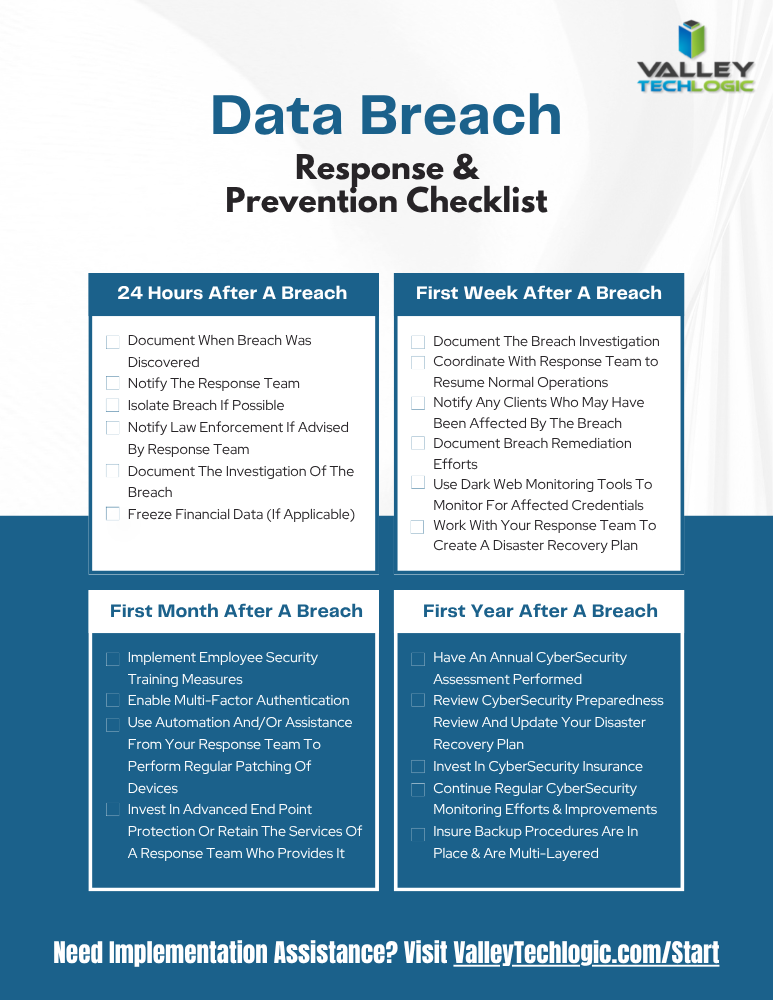
We have a simple template for this you can grab below that also covers breaches within your business:
This does not need to be a 40-page incident response plan. It just needs to be clear enough that your team can act quickly and calmly. The big takeaway is that security does not stop at your own front door.
Modern businesses are built on connected cloud platforms. That brings huge benefits, but it also creates shared risk. A vendor integration, API token, or connected app can become a weak link, even when your own systems are not directly compromised. Small businesses should not respond by abandoning cloud tools, that’s not realistic. The better response is to know which vendors matter, track where your data lives, monitor for breach notices, and have a plan for what to do when something goes wrong. You do not need enterprise-level complexity to do this well. You need consistency, ownership, and a clear process.
Vendor breaches are no longer rare edge cases. They are part of doing business in a cloud-connected world. The businesses that handle them best are not the ones that never use vendors. They are the ones that know their vendors, monitor their risk, and respond quickly when the situation calls for it. At Valley Techlogic, we act as a vendor liaison for clients and can help you monitor and respond to breaches even if they’re not happening to your organization directly. Learn more today through a consultation.

- Rumors and speculations are flying surrounding Anthropic’s Fable 5, why it was shut down and when it might return
- Addressing legacy tech debt, 5 strategic ways to clean up your office and remove covert cyber security threats hidden in plain sight
- An anonymous company accidentally spent 500 million on Claude in one month when it placed no usage limits on employees, and how it relates to your AI strategy as a small business
- AI is making fraud easier and more lucrative, with AI enabled phishing emails seeing 25% higher open rates than human crafted variations
- Agentic search? Google’s annual conference I/O revealed new features coming to search, and how your personal data may integrate into it
This article was powered by Valley Techlogic, leading provider of trouble free IT services for businesses in California including Merced, Fresno, Stockton & More. You can find more information at https://www.valleytechlogic.com/ or on Facebook at https://www.facebook.com/valleytechlogic/ . Follow us on X at https://x.com/valleytechlogic