
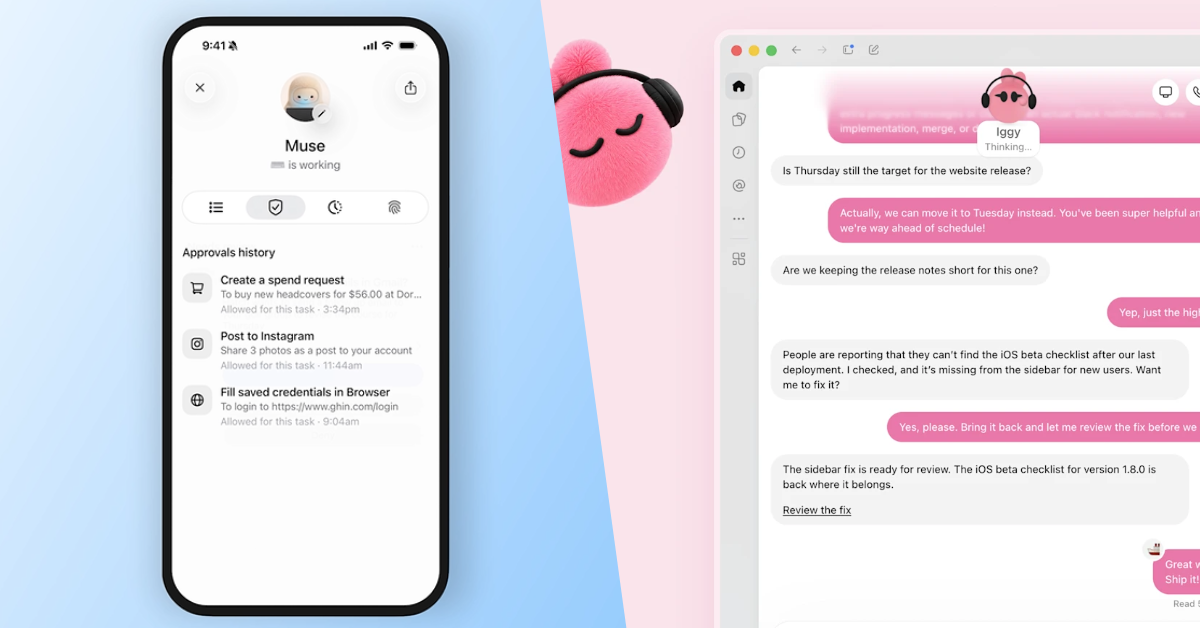
With Muse and Dots, Meta and OpenAI are giving personal AI agents colorful, customizable faces, pairing ambitious automation with the visual appeal of a digital companion. Both products lean into an approachable, character-driven experience, suggesting that the next stage of AI adoption might depend partly on making powerful software feel less intimidating. It is an understandable strategy, but it raises a reasonable question: are these characters making useful technology more accessible, or making people more comfortable with technology they should still approach cautiously?
The strongest answer is that a friendly avatar can serve a legitimate purpose, provided it helps people understand and use the underlying product. There is nothing inherently wrong with making software enjoyable, and professional usefulness does not require an interface that resembles a tax return. The problem begins when affection for a character becomes a substitute for evaluating its accuracy, permissions, and ability to finish a task without creating more work.
Meta introduced Muse on September 8, 2026, describing an agent that operates through its own virtual computer and browser, works across connected services, and continues tasks after the user closes the app. Its advertised capabilities include handling email, researching purchases, completing forms, and coordinating plans. On September 29, Meta expanded that pitch with Muse for Small Business, announcing connections to services including QuickBooks, Shopify, Canva, and Slack. These are concrete attempts to move AI into everyday workflows, although an announced capability should not be confused with independently demonstrated reliability across every situation.
OpenAI introduced Dots on September 29 with a similar emphasis on ongoing responsibility, describing always-on agents with their own cloud computers and access to connected applications. Its examples lean heavily toward sustained professional work, including preparing software fixes, updating project materials, and revising proposals as requirements change. The intended value comes from following work through multiple steps, carrying context forward, and returning results for review. Whether the agent resembles a pet or a colorful creature is secondary to whether it can deliver that continuity dependably.
So where could a friendly face help in the ongoing integration of AI into our daily workflow?Consider someone who wants help organizing a crowded week but has little interest in learning the terminology surrounding AI models, integrations, and automation. A recognizable character could provide an approachable starting point, especially when paired with clear examples and ordinary conversational language. Rather than confronting an empty box and wondering what to ask, that person could be guided toward a specific, useful task. In that situation, personality would support usability by helping the person get started, rather than merely decorating the screen.
There is some research behind the broader idea that presentation influences trust, but it does not justify assuming that cuter automatically means better. A 2025 study combining a research review with experiments found that human-like characteristics could influence perceived trustworthiness, while communication style and voice were more important than appearance and naming. The researchers also identified substantial limitations in the existing evidence, particularly around workplace applications. That suggests the quality of the interaction deserves at least as much attention as the character’s design, and it certainly does not establish that an appealing avatar produces lasting adoption.
Price and access also complicate the idea that this competition will be won through personality. Meta describes Muse as free for most everyday needs, with subscription options for additional use, while OpenAI’s initial Dots rollout centers on eligible Pro and Business Premium users, with an administrator-enabled Enterprise beta. Those differences affect who can try the products before anyone develops an attachment to a character. A reasonable expectation is that affordable access, straightforward setup, and useful integrations will matter more to sustained adoption than which assistant looks better in a promotional video.
For a small business, a meaningful trial might involve reviewing a designated customer inbox, identifying conversations awaiting a response, and preparing drafts for an employee to approve. Another might involve gathering information for a recurring report and highlighting missing records before someone has to chase them manually. These would be valuable outcomes because they address specific responsibilities with understandable boundaries. An avatar could make assigning and reviewing that work more pleasant, but the business should judge the result by what was completed correctly and how much supervision it required.
The same principle applies to personal use, where an assistant might help organize school correspondence, prepare a shopping list, or identify scheduling conflicts. The useful version would respect the user’s preferences and reduce the number of things competing for attention. The irritating version would create another stream of notifications about tasks the person already manages perfectly well. In an early hands-on account, WIRED described both useful suggestions and an unnecessary bill reminder, illustrating how the boundary between assistance and interruption can become part of the product experience.
A character could also earn its place by making the agent’s status easier to understand, although that should be treated as a design opportunity rather than a guaranteed benefit of these launches. Clear indicators for researching, awaiting approval, encountering a problem, or completing work would help users follow what is happening. An animated expression should supplement that information, not force someone to interpret whether a blinking creature is busy, confused, or finished. Users should also be able to choose a restrained interface without losing functionality, because mass-market appeal has to accommodate people who find animated assistants distracting.
The more important concern is whether a companion-like presentation encourages users to grant access before understanding what that access allows. A person might feel comfortable with a familiar character while remaining unclear about which accounts it can read, what it remembers, or which actions it can perform. Those are separate judgments, and product design should help users keep them separate. An appealing name and reassuring tone offer no evidence that a proposed action is appropriate, a conclusion is correct, or a permission is necessary.
Both companies describe controls intended to address these concerns. Meta says Muse for Small Business requires approval before publishing, sending, or spending, while OpenAI describes configurable permissions, action-review mechanisms, and rules governing when Dots must request approval. OpenAI also explicitly warns that Dots can make mistakes and that consequential work should be reviewed. These safeguards deserve more attention than the mascots, and their presence should prompt careful evaluation rather than an assumption that every possible failure has been eliminated.
The details can also be less intuitive than the friendly interface suggests. OpenAI’s documentation states that disconnecting an application does not delete information a Dot has already obtained from it, and that deleting that information requires deleting the Dot. That is precisely the kind of behavior users should understand before connecting personal or business accounts. A product can look simple while still creating complicated questions about access, memory, and deletion, so an approachable design should make those questions easier to answer rather than easier to overlook.
The real test comes after the novelty wears off, a sensible evaluation should begin with a narrow task and measure the entire experience, including setup, checking, corrections, and recovery when something goes wrong. If an assistant saves thirty minutes of preparation but requires forty minutes of verification, its cheerful presentation does not improve the calculation. For businesses, a pilot should also establish who approves external actions, which information is permitted, and how access can be withdrawn. These requirements may be less exciting than customizing a character, but they provide a much stronger basis for deciding whether the product belongs in daily operations.
The avatar itself deserves a similarly practical test: would the same tool be easier to understand and use with the character than without it? That question separates useful interface design from decoration without assuming decoration is inherently bad. A character that helps someone begin a task, understand progress, or recognize when intervention is needed could provide measurable value. A character that primarily encourages more conversation, more notifications, or more emotional attachment would need a different justification, especially when the product is being sold as a way to reclaim time.
Muse and Dots make a plausible case for friendly characters as an introduction to more capable automation, but their long-term appeal will depend on the work behind the animation. Cuteness becomes a gimmick when it distracts from weak results or encourages trust the system has not earned. It becomes useful design when it makes a capable, controllable product easier to understand and more comfortable to use. The winning assistant should ultimately give people fewer things to manage, not another digital personality they have to supervise.
If you would like to have human guidance for your business’s AI endeavors, Valley Techlogic can bring our expertise to the equation. Whether it’s navigating new rollouts in the space or trying to build on existing processes, reinventing your workflows to use AI to speed up productivity and efficiency can feel like trying to drink from a firehose. Let us make things simple, learn more with a consultation today.
- 6 Reasons to restrict admin access to company devices
- Is the AI threat overblown? Why OpenAI, Anthropic and more are cautioning we need to “slow down” on AI innovation and focus on safety
- ChatGPT’s Astra (GPT-6) has been released, is it worth the hype?
- Microsoft is retiring voice and SMS verification in favor of passkeys for Entra users starting February 2027, we tell you how to set this up NOW before you lose access
- Worried about “shadow IT” in your business?
This article was powered by Valley Techlogic, leading provider of trouble free IT services for businesses in California including Merced, Fresno, Stockton & More. You can find more information at https://www.valleytechlogic.com/ or on Facebook at https://www.facebook.com/valleytechlogic/ . Follow us on X at https://x.com/valleytechlogic