

Tag: cmmc audit

  • 2023 is coming, is your business CMMC ready?

    2023 is coming, is your business CMMC ready?

    For some Department of Defense (DoD) contractors, CMMC or Cybersecurity Maturity Model Certification compliance may be a looming figure that they’ve yet to address. If you’re one of the ones currently making headway on it, you may not be certain which level you need to reach for your business.

    CMMC version 2.0 was announced last November, and it seems as if that’s going to be the de facto model going forward. In version one there were 5 levels of CMMC compliance, which have now been reduced to 3. To put it simply, level 1 of the program remained the same, levels 2 and 3 were combined and levels 4 and 5 were also combined.

    This means if you were previously aiming for level 2 in the previous version of the program, you will now need to address topics in level 3 to be compliant.

    Level one or the Foundational Level is meant for who do not handle Federal Contract Information (FCI) data. The checklist features just 17 items, and your compliance is self-attested which means you do not need to have a formal CMMC testing done to be compliant with the program.

    Many DoD contractors though will fall into level 2 or the Advanced Level due to their handling of Controlled Unclassified Information (CUI), level 2 features 110 controls. All of CMMCs level 2 controls originate from NIST SP 800-171.

    With the announcement of version 2.0 it was also announced the additional CMMC specific controls would be removed. If your business has already been working towards compliance with NIST before CMMC was announced you’re in a perfect position to work towards your CMMC compliance goals.

    While 2.0 has not yet been signed into law, it was announced by the Pentagon last April that CMMC language would begin to start showing up in DoD contractors starting July 2023 – so the clock is definitely ticking if your business will be vying for those contracts.

    A small portion of businesses will be required to undertake the rigorous task of being compliant with level 3 of CMMC, or the Expert Level. It’s based on NIST-800-171 and 172 and has 134 requirements at the time of writing, many of which require specialized equipment and software.

    For both levels 2 and 3, audits will be required through the CMMC Accreditation Body (recently renamed Cyber-AB). Cyber-AB is an independent auditing body and we’ve been told the wait times to be audited are lengthy, though this will get a little better as the program gains more auditors. It’s still a good idea to make sure your business is ready and meets the compliance standards though especially as CMMC regulations continue to be rolled out ahead of the official release. You don’t want to be caught needing that proof of compliance to meet your contract requirements and not having it.

    The DoD has also indicated it would take a contractors level of CMMC compliance into consideration when choosing for their contracts – so not being compliant may not just put your existing contracts at risk it could cost you new ones as well.

    We have several articles explaining the levels and controls in more detail, here are our articles on levels one, two and three.

    If you’ve barely scratched the surface in your organization, you can still make changes that will put you in a better position when you begin to tackle it in earnest. Many of the requirements, especially those found in level one, is common sense advice for being safer online. You (and your employees) can work on these five items first:
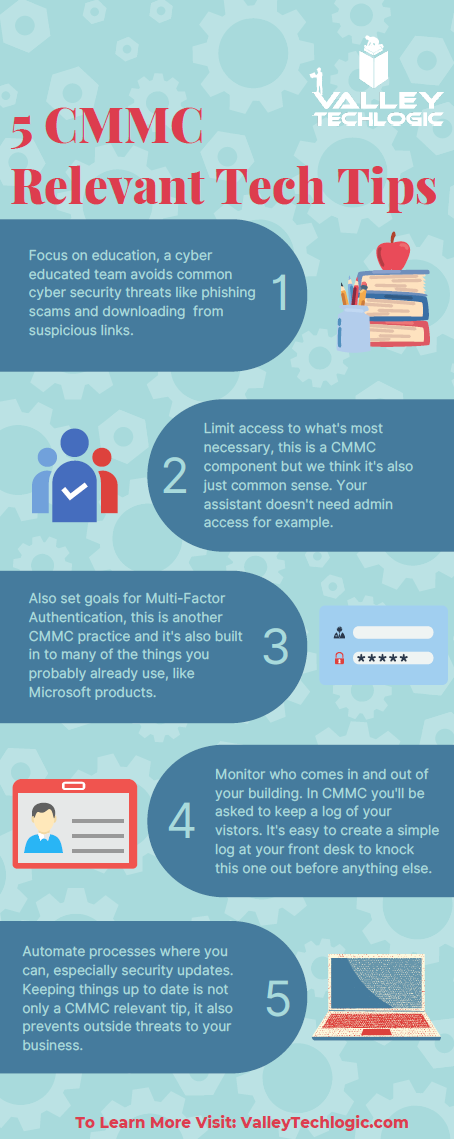
    If after reviewing the information, you feel like you just need a hand to either cement cybersecurity processes you already have in place or have a partner in your CMMC goals, Valley Techlogic can help.

    We have firsthand knowledge of the CMMC program and helping clients become CMMC certified. Our tools will help you meet the requirements necessary and quickly get your business ready for the audit process.

    Make an appointment today for a free consultation to learn more.

    Looking for more to read? We suggest these other articles from our site.

    This article was powered by Valley Techlogic, an IT service provider in Atwater, CA. You can find more information at https://www.valleytechlogic.com/ or on Facebook at https://www.facebook.com/valleytechlogic/ . Follow us on Twitter at https://x.com/valleytechlogic.
  • CMMC Series: The Consequences for CMMC Non-Compliance

    CMMC Series: The Consequences for CMMC Non-Compliance

    You may have thought we finished our series on the Cybersecurity Maturity Model Certification (CMMC) program, but we would be remiss if we didn’t cover the consequences and penalties for not complying with the program if you’re a current Department of Defense (DoD) contractor.

    You may be thinking there’s a window to wait and see while rulings proceed on version 2.0 or have seen dates such as 2025 thrown out as the goal post for when the program will be completely finalized. Or maybe you’re just hoping the whole thing goes away, we get it. Looking at all of the controls and tiers can be overwhelming if your business is new to implementing cybersecurity measures.

    However, the program is here to stay, and your business will be much better equipped to meet the requirements if you begin working on them now. There is a waiting list already for those wishing to obtain their certification earlier, and we expect the wait times to only grow as nearly 40,000 businesses who must comply with this program rush to get their certification before losing eligibility for existing contracts.

    Beyond existing contracts, having your CMMC certification will make your business more competitive when seeking new contracts with the DoD. Progress towards CMMC is an investment in your business’s future, and it also meet the goals of the program which is protecting businesses from cyber threats.

    So, what are the consequences for not working on CMMC compliance now, or in the future?

    The DoD has said that all Defense Industrial Base (DIB) contractors must be compliant by 2025. There are no direct monetary penalties or fines for not being compliant at this time, however your business will no longer be eligible for defense contracts if you have not successfully completed your accreditation by that date.

    Three years may seem like a long time but when you look at the scope of what’s necessary to be compliant with CMMC, it’s really a short window to get your ducks in a row. Tier one could be accomplished relatively easily by most businesses, but if your business handles any Confidential Unclassified Information, you’re really looking at a goal of tier three moving forward (or tier two if/when version 2.0 is released).

    That’s also not counting the time spent in a waiting list for a member of the CMMC Accreditation Body to actually complete your assessment, you will need to work on your self-assessment status and POAM (Plan of Action and Milestones) prior to getting on the waiting list for CMMC accreditation.

    It’s also important to note that your self-assessment must be confirmed by company leadership, it’s not enough to simply have your IT person or team complete the self-assessment and submit it.

    The DoD has said they will randomly test contractor compliance and see if it matches what the contractor has inputted into Supplier Performance Risk System (SPRS). SPRS is a necessary requirement for being compliant with Defense Federal Acquisition Regulation Supplement (DFARS) which many contractors may already be aware of. They will be looking to see if your disclosures for DFARS in regards to CMMC/NIST match.

    Submitting false information could make your business at risk for running afoul of the False Claims Act (FCA), which could leave you liable for civil fines and penalties. There is even a program in place to reward whistleblowers who bring to light businesses who are falsifying information about their cybersecurity practices on these forms.

    This is all so much to say as there are significant risks involved with ignoring CMMC and we suggest you begin working on it now or we’re afraid you’ll be paying for it later.

    If you need assistance with working on your CMMC accreditation, cybersecurity practices and compliance, DFARS forms or more – Valley Techlogic can assist you. Schedule a consultation today to learn how we can help your business meet your CMMC compliance goals for 2022.

    VTL Can Help With Your CMMC Progress!

    Looking for more to read? We suggest these other articles from our site.

    This article was powered by Valley TechLogic, IT service provider in Atwater, CA. You can find more information at https://www.valleytechlogic.com/ or on Facebook at https://www.facebook.com/valleytechlogic/ . Follow us on Twitter at https://x.com/valleytechlogic.
  • CMMC Series: Tier Two Overview

    CMMC Series: Tier Two Overview

    This is the third week of our Cybersecurity Maturity Model Certification (CMMC) Series. You can find week one, which was a look at what’s happening with CMMC in 2022 here. Last week, we gave you an overview of tier one which you can review here.

    Tier one in CMMC really covers the basic foundational steps you must take to move on to tier two and tier three. For some contractors, tier one will be enough to keep and maintain compliance with their Department of Defense (DoD) contracts. Every situation is unique, but broadly speaking if you don’t handle Controlled Unclassified Information (CUI) in your business – tier one will probably be the extent that you need to reach.

    If you do handle any CUI data, then we recommend you strive towards tier two or tier three. Many of the protections that come in the later tiers specifically cover how to safeguard this data and it’s in your businesses best interest to meet the requirements. While there are no direct financial penalties at the time of writing for not doing so, the DoD is considering a system of rewarding businesses who achieve greater CMMC maturity levels.

    If you and another business are exactly the same in what you do and, in your pricing, – or even if their pricing is a bit higher than yours – if they have achieved tier three cybersecurity maturity model certification and your business is tier one or not certified at all yet, it’s likely your competitor will win the bid.

    So, what goes into reaching tier two in CMMC?

    Tier two is the next milestone within CMMC, and the difficulty does scale considerably with each level. While tier one had 17 provisions, tier two introduces 55 more for a total of 72 practices you’ll need to cover to meet the requirements (the practices are cumulative).

    In addition to more practices tier two also introduces new domains.

    First there is Access Control, tier two access control looks to limit access to who can log into your organizations systems (and how much they can access when they do).

    Next is Awareness and Training, in tier two you will need to make sure your managers, administrators and anyone else you who would have access to sensitive systems is attending regular cybersecurity training.

    In Audit and Accountability, we look to maintain logs of user activity for review.

    Security Assessment is where we really begin to see accountability being held on organizations, you will need to conduct regular assessments as you work towards your cybersecurity goals and develop cybersecurity plans based on the assessment results.

    Configuration Management covers the need to manage the configurations of your office devices and equipment with cybersecurity best practices in mind.

    Identification and Authentication is similar to access control, but it specifically looks to limit sensitive systems to only those who should have authorization to access them.

    While tier one in CMMC only covered the basics and didn’t address what happens when you have a cyber incident, tier two starts to cover that with the Incident Response control.

    The Maintenance control in tier two actually refers to your devices and how you maintain them, and what you will need to do in case of their failure.

    Media Protection in tier two covers specific provisions around the handling and destruction of removable media, such as flash drives.

    We started looking at Physical Protection in tier one by keeping visitor logs, but tier two asks that you actually begin to escort guests through your facilities and screening personnel.

    Tier one surprisingly doesn’t ask that you backup your data (even though we would always recommend that) – in tier two Recovery you must have a plan for backing up your data.

    In tier two Risk Management, CMMC asks that you begin to conduct risk assessments and fix any vulnerabilities that are uncovered during the process.

    Systems and Communications Protection in tier two includes controlling communications within your organization, not just monitoring them.

    Finally, the System and Information Integrity domain covers actively monitoring your systems for breaches and quickly resolving any that come up.

    As you can see, CMMC maturity tier two dives into the deep end of cybersecurity, but the provisions it covers will make a discernible impact in your cyber readiness throughout your entire business.

    Does your business need to meet the requirements for being certified with CMMC? Valley Techlogic can help, we have experience helping DoD contracted businesses reach their cybersecurity and CMMC goals, as well as helping with the certification process itself. Learn more today in a free consultation.

    Looking for more to read? We suggest these other articles from our site.

    This article was powered by Valley TechLogic, IT service provider in Atwater, CA. You can find more information at https://www.valleytechlogic.com/ or on Facebook at https://www.facebook.com/valleytechlogic/ . Follow us on Twitter at https://x.com/valleytechlogic.