
Tag: NIST

  • 8 Tips for Practicing Good Cybersecurity Hygiene in your Business

    8 Tips for Practicing Good Cybersecurity Hygiene in your Business

    We all know about good hygiene practices for ourselves and our homes, but what about practicing good cybersecurity hygiene? What does the word hygiene mean when applied to a digital context?

    When we think of hygiene for cybersecurity it’s the essential items needed to practice the bare minimum in cyber threat prevention, we’re strong advocates for advanced cybersecurity threat prevention and believe you can never be too protected – however these 8 items will in many cases prevent the vast majority of outside threats. As a bonus? The only thing you’ll need to spend to enact these in your business today is a little time.

    1. Use Strong and Unique Passwords
      Implement complex passwords and enable multi-factor authentication (MFA) for added security. We have a guide for what a strong password looks like and how to utilize MFA here.
    2. Regularly Update Software and Systems
      Keep your operating systems, applications, and antivirus software up to date to patch vulnerabilities.
    3. Educate Employees on Cybersecurity Best Practices
      Train staff on recognizing phishing scams, suspicious emails, and safe browsing habits. Interested in cybersecurity training for your business? Valley Techlogic includes it (at no additional cost) in all of our plans.
    4. Limit Access to Sensitive Data
      Implement role-based access controls and grant permissions only to those who need them.
    5. Enable Firewalls and Antivirus Protection
      Use firewalls, antivirus programs, and other security tools to prevent unauthorized access.
    6. Backup Data Regularly
      Perform frequent backups and store them in secure, off-site locations to prevent data loss from ransomware attacks.
    7. Monitor Network Activity
      Use intrusion detection systems and regularly review logs for unusual activity.
    8. Implement Secure Wi-Fi and VPN Usage
      Use encrypted Wi-Fi networks and require VPN usage for remote employees to protect data transmission.

    Implementing these 8 cybersecurity threat preventions will protect your business from most attacks, but if you’re looking to go a little further below are 4 cybersecurity benefits included with all Valley Techlogic service plans:
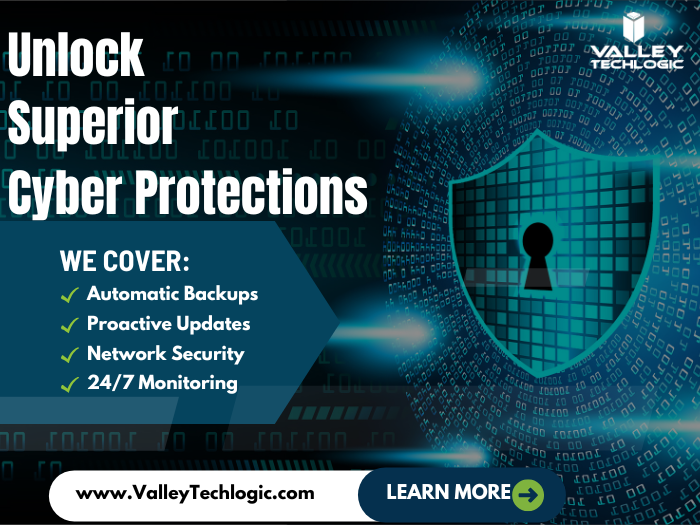
    Want to learn more? Schedule a consultation with us today.

    Looking for more to read? We suggest these other articles from our site.

    This article was powered by Valley Techlogic, leading provider of trouble free IT services for businesses in California including Merced, Fresno, Stockton & More. You can find more information at https://www.valleytechlogic.com/ or on Facebook at https://www.facebook.com/valleytechlogic/ . Follow us on X at https://x.com/valleytechlogic and LinkedIn at https://www.linkedin.com/company/valley-techlogic-inc/.


  • CMMC Changes for 2024 Summarized

    CMMC Changes for 2024 Summarized

    On December 26th 2023 the DoD (Department of Defense) dropped a slightly belated Christmas gift on defense contractors and vendors in the form of big changes to the CMMC (Cybersecurity Maturity Model Certification) program.

    Whether the timing of the info dump was intentional or not remains a matter of debate but what’s not up for debate is that these changes are now the law of the land when it comes to reaching your CMMC goals (at least until they’re possibly challenged in court but we wouldn’t hold our breath on that). If you have not started working on them yet this is your sign to get started ASAP.

    The 234-page document covered a variety of updates to the program, including splitting up tier 2 into self-attestation OR requiring contractors and vendors to obtain a third-party audit, but for those actively working on it we’re happy to say the controls themselves remain unchanged.

    The vast majority of contractors (63% as estimated by the DoD) will still fall under CMMC Level 1 but a new change will not allow these contractors to submit a POA&M (Plan of Action and Milestones) to comply with unmet milestones going forward.

    For contractors falling under Level 2 and 3 they can still submit a POA&M but while it previously allowed contractors to set their own timing for completing the actions required the new rules state all POA&M must have a plan for completion within 180 days of the initial assessment.

    This is a huge change and will make it very difficult for contractors who are trying to rush to get their accreditation to comply with existing contracts. There are also new limitations on POA&Ms and some controls don’t allow them to be completed under a POA&M at all.

    DoD contractors and vendors will have to rethink their entire plan for coming into compliance with CMMC this year.

    The good news is that if you do meet all of the new hurdles and pass your assessment you will be in the clear for 3 years.

    For those in the CMMC level 2 category (an estimated 37% of those affected) whether or not you can still self-attest in SPURs (Supplier Performance Risk System) or will need a third-party assessment is dependent entirely on whether the CUI (Controlled Unclassified Information) found in your contract warrants one or the other as determined by the DoD.

    As these rules are still rolling out Level 2 contracts will most likely be required to self-attest to start until the program gains its footing when we’ll start to see more required to take on a third-party assessment. Contractors should be prepared either way as they perform the actions needed to qualify for certification.

    There’s good news for Level 3 contractors in that not much has changed for them, and the program overall is still based on guidance from NIST SP 800-172. New language was added that CMMC Level 3 contractors must maintain a perfect Level 2 score in addition to achieving 20 out of 24 points to meet the qualifications for Level 3. Only a small minority of contractors will need to worry about achieving Level 3 and we have no doubt those that qualify know who they are and were already well prepared for this news.

    The proposed roll out of these changes and CMMC as a whole is under a phased implementation window that will expand across a three-year period. Beginning with the DoD looking at those soliciting new DoD contracts to have a Level 1 or Level 2 self-attested score all the way up to the inclusion of CMMC in all new and existing contracts by year three.

    It should also be noted that those who misrepresent their level of readiness under the CMMC program can face some pretty sharp penalties for doing so.

    To add salt to the wounds the DoD have given themselves a grace period up to 2027 to begin rolling out these changes within their own organization – rules for thee but not for me? Perhaps a little bit.

    These weren’t the only changes to be announced in December, if you would like to see and read the full 234-page document yourself you can find it here.

    Either way the time to get your ducks in a row was several years ago (CMMC 2.0 was released in 2021) but short of inventing a time machine to do so the second best time to start is now.

    Valley Techlogic has worked with clients on readiness for a variety of cybersecurity compliance frameworks including but not limited to CMMC, HIPAA, NIST, CIS and more. If you would like to learn more about how we can help you meet your CMMC goals, reach out today.

    Looking for more to read? We suggest these other articles from our site.

    This article was powered by Valley Techlogic, an IT service provider in Atwater, CA. You can find more information at https://www.valleytechlogic.com/ or on Facebook at https://www.facebook.com/valleytechlogic/ . Follow us on Twitter at https://x.com/valleytechlogic.

  • 2023 is coming, is your business CMMC ready?

    2023 is coming, is your business CMMC ready?

    For some Department of Defense (DoD) contractors, CMMC or Cybersecurity Maturity Model Certification compliance may be a looming figure that they’ve yet to address. If you’re one of the ones currently making headway on it, you may not be certain which level you need to reach for your business.

    CMMC version 2.0 was announced last November, and it seems as if that’s going to be the de facto model going forward. In version one there were 5 levels of CMMC compliance, which have now been reduced to 3. To put it simply, level 1 of the program remained the same, levels 2 and 3 were combined and levels 4 and 5 were also combined.

    This means if you were previously aiming for level 2 in the previous version of the program, you will now need to address topics in level 3 to be compliant.

    Level one or the Foundational Level is meant for who do not handle Federal Contract Information (FCI) data. The checklist features just 17 items, and your compliance is self-attested which means you do not need to have a formal CMMC testing done to be compliant with the program.

    Many DoD contractors though will fall into level 2 or the Advanced Level due to their handling of Controlled Unclassified Information (CUI), level 2 features 110 controls. All of CMMCs level 2 controls originate from NIST SP 800-171.

    With the announcement of version 2.0 it was also announced the additional CMMC specific controls would be removed. If your business has already been working towards compliance with NIST before CMMC was announced you’re in a perfect position to work towards your CMMC compliance goals.

    While 2.0 has not yet been signed into law, it was announced by the Pentagon last April that CMMC language would begin to start showing up in DoD contractors starting July 2023 – so the clock is definitely ticking if your business will be vying for those contracts.

    A small portion of businesses will be required to undertake the rigorous task of being compliant with level 3 of CMMC, or the Expert Level. It’s based on NIST-800-171 and 172 and has 134 requirements at the time of writing, many of which require specialized equipment and software.

    For both levels 2 and 3, audits will be required through the CMMC Accreditation Body (recently renamed Cyber-AB). Cyber-AB is an independent auditing body and we’ve been told the wait times to be audited are lengthy, though this will get a little better as the program gains more auditors. It’s still a good idea to make sure your business is ready and meets the compliance standards though especially as CMMC regulations continue to be rolled out ahead of the official release. You don’t want to be caught needing that proof of compliance to meet your contract requirements and not having it.

    The DoD has also indicated it would take a contractors level of CMMC compliance into consideration when choosing for their contracts – so not being compliant may not just put your existing contracts at risk it could cost you new ones as well.

    We have several articles explaining the levels and controls in more detail, here are our articles on levels one, two and three.

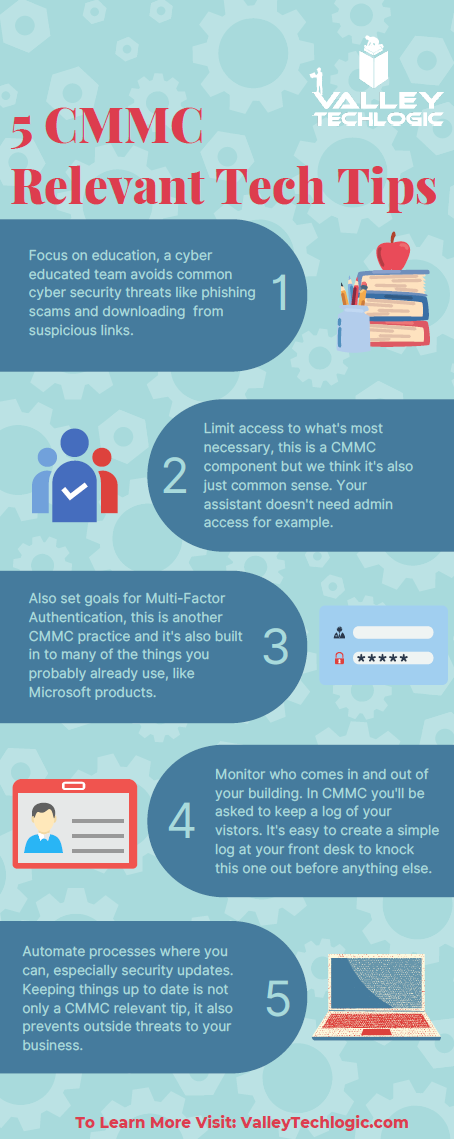
    If you’ve barely scratched the surface in your organization, you can still make changes that will put you in a better position when you begin to tackle it in earnest. Many of the requirements, especially those found in level one, is common sense advice for being safer online. You (and your employees) can work on these five items first:

    If after reviewing the information, you feel like you just need a hand to either cement cybersecurity processes you already have in place or have a partner in your CMMC goals, Valley Techlogic can help.

    We have firsthand knowledge of the CMMC program and helping clients become CMMC certified. Our tools will help you meet the requirements necessary and quickly get your business ready for the audit process.

    Make an appointment today for a free consultation to learn more.

    Looking for more to read? We suggest these other articles from our site.

    This article was powered by Valley Techlogic, an IT service provider in Atwater, CA. You can find more information at https://www.valleytechlogic.com/ or on Facebook at https://www.facebook.com/valleytechlogic/ . Follow us on Twitter at https://x.com/valleytechlogic.

  • Cyber Insurance – What you can do to ensure your business will be covered in 2022

    Cyber Insurance – What you can do to ensure your business will be covered in 2022

    Last month we released our new cyber insurance report which is an in depth look into this topic, but we wanted to touch on what we’re specifically seeing so far in 2022 in today’s article because from what we’re seeing in from our clients and in the industry – cyber insurance requirements are on the rise.

    If you’re new to cyber insurance or aren’t sure what’s covered under this sort of policy, for most insurance providers cyber insurance offers coverage for technology related disasters. This could include a cybersecurity event such as ransomware or a data breach but depending on your level of policy it might also include IT related downtime not related to cybersecurity such as internet outages. You may even see coverage for specific device issues, such as the loss of an office server that’s critical for day-to-day operations.

    When it comes to the cybersecurity related coverage what many people don’t realize is it’s not only meant for covering your own losses, but also the potential loss incurred by your customers. If you have a data breach, your cyber insurance coverage will cover the cost of any litigation brought by your customers and it may also cover items such as on-going credit monitoring if their PII (personal identifying information) was exposed in the data breach your company suffered.

    It can be easy to feel detached from a loss you haven’t suffered yet. To put some perspective to, it during the Anthem data breach in 2015 when involved 80 million patient records, their costs to notify their customers (which HIPAA regulations stipulate must be done by snail mail) exceeded $40 million in just postage. That’s not even taking into consideration all of the other costs associated with that breach.

    They’re a major corporation, so again it may be difficult to imagine yourself in those shoes, but even for small companies the average costs are as high as $200,000 per breach. Also, if you’re hit with a ransom and think you can just pay it and get out intact, think again. Many times, even if you receive the de-encryption key from the hackers your data may still be lost.

    It’s not surprising that insurance providers are looking at this and wondering how they can alleviate some of the risk they’re taking providing insurance to customers going forward. The requirements are increasing, even for us as a technology provider for businesses we’re seeing longer forms that we’re assisting our customers with when they go to acquire a new cyber insurance policy.

    These longer forms are featuring more difficult questions as well. We have made cybersecurity a staple feature of our plans so our customers are in a good place for obtaining a cyber insurance policy, but the truth is if cybersecurity has been on the back burner for your business, you may have a difficult time in 2022 and beyond finding an insurer that’s willing to cover you.

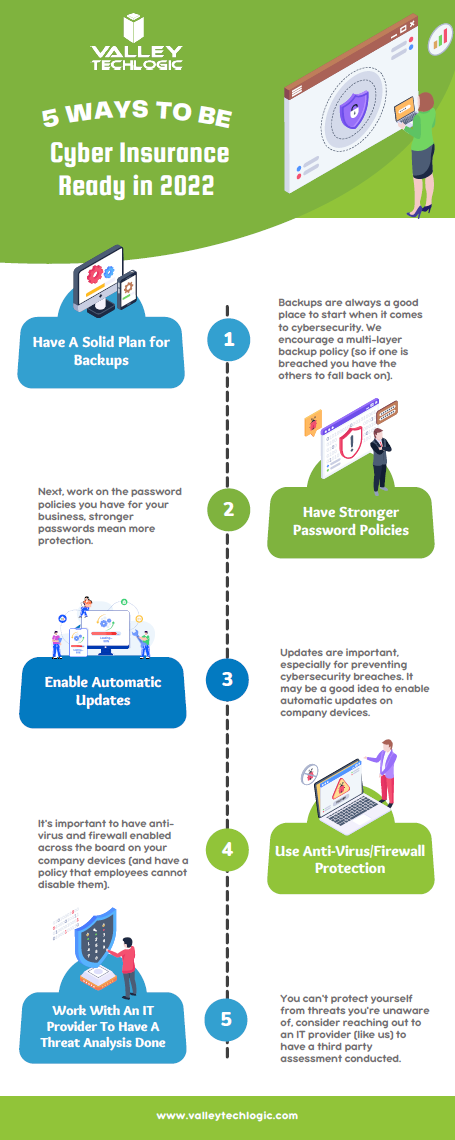
    As an idea of where to start before you go to obtain a cyber insurance policy, we’ve created this checklist of items you can begin to work on to put your business in a better position this year.

    Be Cyber Insurance Ready in 2022
    Click to grab the full size version.

    Many of the items listed are easy for even someone who’s not very tech savvy to tackle, but if you’d really like to protect your business from hackers this year, we suggest teaming up with a tech provider like Valley Techlogic.

    Cybersecurity is a core focus for our business, we will match your business with a cybersecurity framework that makes sense – for example CMMC for defense contractors, HIPAA for healthcare providers, NIST or CIS for small and medium sizes businesses of any industry – and use that framework to have a concrete game plan for making sure your networks and devices are impenetrable to bad actors. Learn more today with a quick consultation

    Looking for more to read? We suggest these other articles from our site.

    This article was powered by Valley TechLogic, IT service provider in Atwater, CA. You can find more information at https://www.valleytechlogic.com/ or on Facebook at https://www.facebook.com/valleytechlogic/ . Follow us on Twitter at https://x.com/valleytechlogic.

  • CMMC Series: Tier One Overview

    CMMC Series: Tier One Overview

    Last week we covered a general overview of what the Cybersecurity Maturity Model Certification (CMMC) program is and what’s been announced for 2022 so far. Presently, there are five maturity tiers found in program, although if (or when) version 2.0 is released it’s been announced that the program will be simplified down to just three tiers.

    The changes that will be happening with version 2.0 however don’t affect tier one very much. Tier one covers basic cybersecurity hygiene in both versions of the program. It sets the groundwork for the later tiers and while the topics covered are “basic”, the foundational coverage they provide is imperative for any business – not just those required to adhere to CMMC for contractual or compliance reasons.

    The Cybersecurity Maturity Model Certification (CMMC) program includes 17 controls at the moment with 171 practices. Thirty of those practices are only found within CMMC and not in the framework which formed the basis for it (NIST) and are anticipated to be removed in version 2.0. However, in both version 1.0 and 2.0 there are 17 practices that must be adhered to for tier one.

    It’s important to note as well this process is not one and done, you must actively maintain your cybersecurity compliance to continue being certified within CMMC. Failure to do so could result in losing your certification, losing contracts that require CMMC compliance, and or even being fined for violating the False Claims Act (FCA) which will talk about in more detail in a future article.

    It’s beneficial to maintain your compliance to both adhere to the program and protect your business from cyber threats.

    In tier one the program begins with “Access Control” and there are five components. These components cover topics such as user privileges and controlling remote access and access to internal systems.

    The next control is “Identification and Authentication” which aligns well with Access Control, the two practices found within that control involve documenting those that access your systems and maintaining reports for those logins.

    Then we have “Media Protection” which has just one practice and it’s aimed at maintaining sanitation of your devices (such as removing sensitive data from hard drives).

    Next, we have “Physical Protection” and in tier one of CMMC this topic covers improving the way you surprise visitors to your office location (a lot of cyber threats stem from an attack known as “spear phishing”). There are four practices found under “Physical Protection”.

    “System and Communication Protection” has two practices and they’re both aimed at securing the private communication you and your employees have (that may include CUI – Controlled Unclassified Information – data).

    Finally, we have “System and Information Integrity” which has five practices that cover better securing your businesses systems, including performing needed updates, and monitoring for malicious code.

    As you can see, these basic practices set a good baseline for activities found in higher maturity tiers. In tier one “System and Information Integrity” you’re monitoring for malicious code – in tier two and three there are practices that stipulate how to actually deal with it.

    We will be continuing to provide more information on CMMC in this series, next week we will take an in depth look at tier two. If your business needs to meet the requirements for being CMMC certified, Valley Techlogic can help. We have experiences helping businesses achieve greater cybersecurity compliance and assisting them with the certification process. Learn more today.

    Looking for more to read? We suggest these other articles from our site.

    This article was powered by Valley TechLogic, IT service provider in Atwater, CA. You can find more information at https://www.valleytechlogic.com/ or on Facebook at https://www.facebook.com/valleytechlogic/ . Follow us on Twitter at https://x.com/valleytechlogic.

  • CMMC Series: What’s Happening in 2022

    CMMC Series: What’s Happening in 2022

    We’ve touched on the Cybersecurity Maturity Model Certification (CMMC) before in this blog, but over the next five weeks we’ll be doing a deep dive into this particular cybersecurity framework in our new CMMC Series. Starting with today’s post on what’s happening currently and what we can expect in 2022.

    At Valley Techlogic, we believe a good cybersecurity framework can be the backbone for businesses looking to beef up their cybersecurity implementation. The roadmaps found within frameworks such as CMMC, HIPAA, CIS and NIST act as a perfect guide whether you’ve been implementing cybersecurity strategies for a while or are brand new to the process.

    Our focus on CMMC occurs as the program is set to go through changes. CMMC Version 1.0 was released January 31st, 2020, and while it borrowed most of its components from NIST, it did have 30 additional requirements that aren’t found in the National Institute of Standards and Technology (NIST) framework.

    Those additional standards will not exist in version 2.0 however, as the Department of Defense (DoD) moves to simplify the program and roll back any government oversight that may overreaching. Version 2.0 will allow more companies to self-certify as well.

    Rolling out a new version of anything in the government is a time intensive process, since the new changes were announced it’s anticipated it could take anywhere from 9 months to 24 months before a ruling is established. Also, some groups who are currently involved in implementing CMMC are protesting the changes.

    Regardless of what version exists, we’re past the point where businesses who hold contracts with the DoD can choose to ignore the writing on the wall. You will need to start implementing these security measures now if you haven’t already if you want to maintain your compliance with the DoD rules for their contractors. Whether 2.0 passes or not, CMMC is not going away.

    CMMC accreditation audits are expected to kick off soon, and there’s even some talks about incentivizing businesses who receive their CMMC certifications before it’s officially required. CMMC certification also lets your customers know you take securing their data seriously within your organization.

    Whether it’s 5 tiers found in the existing model or 3 tiers found in 2.0, the best place to start is in the first tier. These changes are easy to quickly implement and will lay the foundation for future cybersecurity improvements. At Valley Techlogic, we have experience helping businesses implement the requirements found within CMMC (as well as NIST, HIPAA, CIS and more).

    We can help your business self-certify and prepare for CMMC accreditation. We can quickly bring you to compliance with tier one and set goals for the more advanced levels.

    Over the next weeks we will talk about the goals found within tier one and beyond in this ongoing CMMC series. If you’re hoping to meet the qualifications for CMMC accreditation in 2022, schedule a meeting with us today to learn how we can help with the process.

    Looking for more to read? We suggest these other articles from our site.

    This article was powered by Valley TechLogic, IT service provider in Atwater, CA. You can find more information at https://www.valleytechlogic.com/ or on Facebook at https://www.facebook.com/valleytechlogic/ . Follow us on Twitter at https://x.com/valleytechlogic.

  • Cybersecurity Maturity Model Certification 2.0 has been announced, what it means for you and your business

    Cybersecurity Maturity Model Certification 2.0 has been announced, what it means for you and your business

    If you’re a contractor or subcontractor for the Department of Defense (DoD) you probably at least have an awareness of the evolving situation surrounding the CMMC (Cybersecurity Maturity Model Certification) program, or maybe you’ve even begun the self-assessment process.

    Announced summer of 2019, version 1.0 was released January 31st, 2020, and a 5 year roll out was planned to get DoD contractors and subcontractors compliant with the framework. The framework is based on the security controls found in the National Institute of Standards and Technology (“NIST”) Special Publication (“SP”) 800-171, with many of the security controls found in CMMC having a direct correlation to a control found in NIST 800-171.

    While the initial CMMC framework was aimed at bringing defense contractors up to speed in their cybersecurity efforts to protect critical Controlled Unclassified Information (CUI), the use of the broad term CUI instead of the defense specific Covered Defense Information (CDI) phrase may indicate that this framework will extend beyond just defense contractors in the future.

    The controls found in NIST are applicable to businesses of all sizes and in all sectors so following the CMMC or NIST frameworks whether or not you’re defense contractor/subcontractor will mean your business will be well protected and compliant with rules and regulations set by your vendors, clients, and services for your business such as cybersecurity insurance.

    In it’s original iteration there were 5 maturity levels found in CMMC, with levels 1-3 really closely following NIST and 4-5 going beyond the scope of what NIST covers. They were described as “maturity levels” as they were meant to measure the maturity of the cybersecurity practices found within your organization.

    For most defense contractors, reaching level 3 of CMMC would be an ideal goal. Levels 4 and 5 covered practices outside the scope of most business’s and would require more specialized (and expensive) security practices. Even in version one of CMMC contractors were allowed to self-certify for maturity level 1, but beyond that would require outside certification. The waiting list to receive that certification is long, so planning to implement the required cybersecurity measures and getting on the waiting list to be certified ASAP is a good idea.

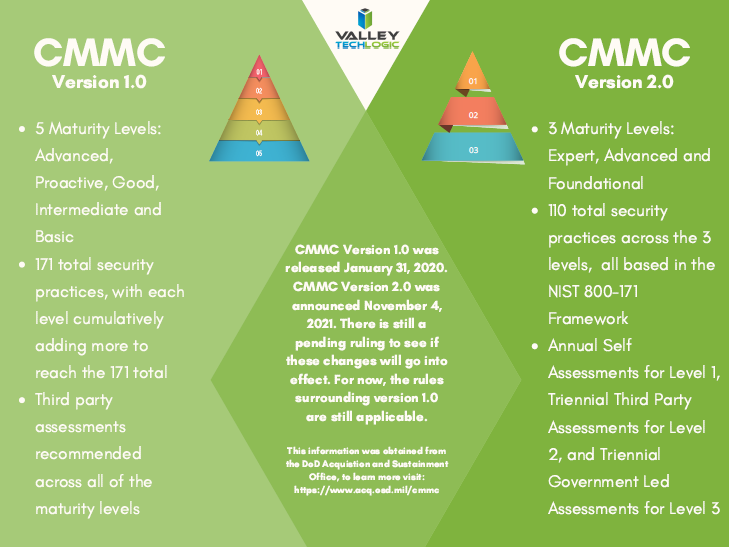
    Now, as of November 4th the DoD has announced an update to CMMC. Version 2 may be removing two of the levels and some of the security measures that were unique to CMMC framework, making the framework match NIST even more closely. Below is the chart we have created with the outlined changes as we know them and as of this posting.

    CMMC Version 1 and 2 Chart
    Click to view the full size.

    This is an evolving situation and as the rollout progresses it’s imperative that businesses that receive DoD contracts begin or continue to increase their efforts in becoming CMMC certified, which may mean drastically increasing your cybersecurity efforts across the board.

    Valley Techlogic has experience in helping businesses meet the goals found within the CMMC framework and we’re ready to help your business meet your certification and cybersecurity goals today. Click here to schedule a quick consultation to find out more.

    Looking for more to read? We suggest these other articles from our site.

    This article was powered by Valley TechLogic, adns, n IT service provider in Atwater, CA. You can find more information at https://www.valleytechlogic.com/ or on Facebook at https://www.facebook.com/valleytechlogic/ . Follow us on Twitter at https://x.com/valleytechlogic.

  • How much are you worth on the Dark Web?

    How much are you worth on the Dark Web?

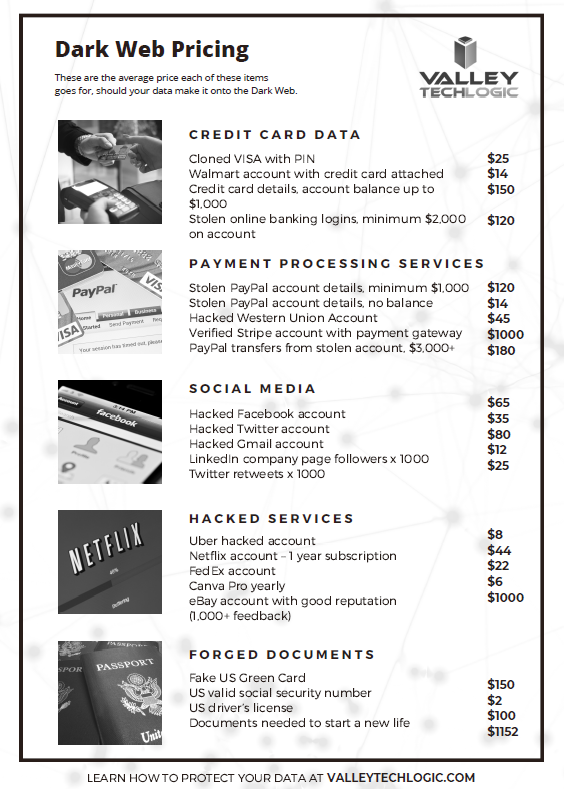
    Not you specifically, but the data that makes up your online activities and private details? What about your various web accounts, for example did you know a hacked Netflix account with 12 months of service is worth $44 on the Dark Web as of 2021?

    We know the Dark Web is a nebulous concept and most of the people we talk to really don’t feel as though it has much to do with them. There’s even those that have resigned themselves to the fact their data is just “out there”, but take solace that in the flux of so many people who experience identify theft (1, 387, 615 reported cases in 2020) there’s just no way a hacker would ever reach them personally.

    If you’re a business owner this is of course, a crock of baloney. While there are many business owners in the US, their numbers pale in comparison to the vast swafts of people who don’t own a business and thereby don’t have valuable employee and financial data within their purview. The fact is by simply owning a business, you’re more vulnerable to being a target of identity theft.

    Business identity theft and consumer identity theft typically occur with the same goal in mind, financial gain for the bad actor. However, business identity theft carries a much larger trickle-down effect. It’s not only your own data that’s at risk, there’s also that of your employees and your business itself.

    Business size doesn’t affect the rate at which you’ll be targeted either, in fact during the COVID pandemic, business identity theft soared across the board.

    This all leads us back to what hackers hope to gain and what your financial data and other pertinent details and accounts are really worth on the dark web, we’ve created this chart with some notable items, but you can find the whole list for 2021 here:

    Click to grab the full size version.

    As the website above states, the quantity of these items found on the dark web also has grown considerably in the last year. It’s predicted cyber theft will cost the world $10.5 trillion annually by 2025. Cyber crime is more profitable than the global drug trade at this point in time.

    So instead of thinking “it won’t happen to me” you should begin considering what you will do when it does happen to you, or even better – what you can do to stop it.

    For instance, at Valley Techlogic we provide all of our customers with Dark Web Monitoring as a routine part of their services with us.

    Dark web monitoring won’t stop your details from being leaked but it will help you monitor and prevent further damage. If your credentials are made available to hackers and you’re aware of it, it’s a lot easier to change them ahead of any damage being done to your accounts and systems.

    You can also partner with an IT provider who has a cyber security stack that exceeds what you could procure on your own. This allows you to take advantage of a robust cyber security package without trying to manage and absorb the cost yourself, allowing you to protect your business and even save money.

    Finally, your provider can help you comply with a cybersecurity framework recommended by the US government, such as NIST or CMMC. This will offer you the best most comprehensive protection from business identity theft.

    Valley Techlogic can assist you with all of these recommended cybersecurity practices. Learn more by taking a quick 10 minute discovery call with one of our tech experts.

    Looking for more to read? We suggest these other articles from our site.

    This article was powered by Valley TechLogic, an IT service provider in Atwater, CA. You can find more information at https://www.valleytechlogic.com/ or on Facebook at https://www.facebook.com/valleytechlogic/ . Follow us on Twitter at https://x.com/valleytechlogic.