
Tag: CMMC

  • 8 Tips for Practicing Good Cybersecurity Hygiene in your Business

    8 Tips for Practicing Good Cybersecurity Hygiene in your Business

    We all know about good hygiene practices for ourselves and our homes, but what about practicing good cybersecurity hygiene? What does the word hygiene mean when applied to a digital context?

    When we think of hygiene for cybersecurity it’s the essential items needed to practice the bare minimum in cyber threat prevention, we’re strong advocates for advanced cybersecurity threat prevention and believe you can never be too protected – however these 8 items will in many cases prevent the vast majority of outside threats. As a bonus? The only thing you’ll need to spend to enact these in your business today is a little time.

    1. Use Strong and Unique Passwords
      Implement complex passwords and enable multi-factor authentication (MFA) for added security. We have a guide for what a strong password looks like and how to utilize MFA here.
    2. Regularly Update Software and Systems
      Keep your operating systems, applications, and antivirus software up to date to patch vulnerabilities.
    3. Educate Employees on Cybersecurity Best Practices
      Train staff on recognizing phishing scams, suspicious emails, and safe browsing habits. Interested in cybersecurity training for your business? Valley Techlogic includes it (at no additional cost) in all of our plans.
    4. Limit Access to Sensitive Data
      Implement role-based access controls and grant permissions only to those who need them.
    5. Enable Firewalls and Antivirus Protection
      Use firewalls, antivirus programs, and other security tools to prevent unauthorized access.
    6. Backup Data Regularly
      Perform frequent backups and store them in secure, off-site locations to prevent data loss from ransomware attacks.
    7. Monitor Network Activity
      Use intrusion detection systems and regularly review logs for unusual activity.
    8. Implement Secure Wi-Fi and VPN Usage
      Use encrypted Wi-Fi networks and require VPN usage for remote employees to protect data transmission.

    Implementing these 8 cybersecurity threat preventions will protect your business from most attacks, but if you’re looking to go a little further below are 4 cybersecurity benefits included with all Valley Techlogic service plans:
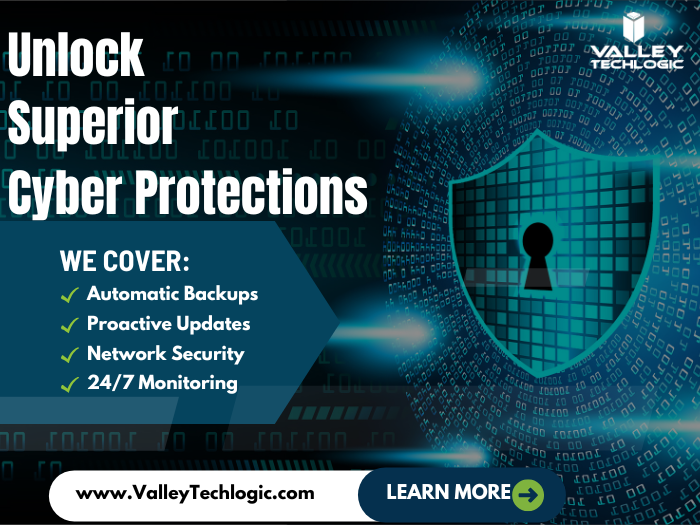
    Want to learn more? Schedule a consultation with us today.

    Looking for more to read? We suggest these other articles from our site.

    This article was powered by Valley Techlogic, leading provider of trouble free IT services for businesses in California including Merced, Fresno, Stockton & More. You can find more information at https://www.valleytechlogic.com/ or on Facebook at https://www.facebook.com/valleytechlogic/ . Follow us on X at https://x.com/valleytechlogic and LinkedIn at https://www.linkedin.com/company/valley-techlogic-inc/.


  • CMMC Changes for 2024 Summarized

    CMMC Changes for 2024 Summarized

    On December 26th 2023 the DoD (Department of Defense) dropped a slightly belated Christmas gift on defense contractors and vendors in the form of big changes to the CMMC (Cybersecurity Maturity Model Certification) program.

    Whether the timing of the info dump was intentional or not remains a matter of debate but what’s not up for debate is that these changes are now the law of the land when it comes to reaching your CMMC goals (at least until they’re possibly challenged in court but we wouldn’t hold our breath on that). If you have not started working on them yet this is your sign to get started ASAP.

    The 234-page document covered a variety of updates to the program, including splitting up tier 2 into self-attestation OR requiring contractors and vendors to obtain a third-party audit, but for those actively working on it we’re happy to say the controls themselves remain unchanged.

    The vast majority of contractors (63% as estimated by the DoD) will still fall under CMMC Level 1 but a new change will not allow these contractors to submit a POA&M (Plan of Action and Milestones) to comply with unmet milestones going forward.

    For contractors falling under Level 2 and 3 they can still submit a POA&M but while it previously allowed contractors to set their own timing for completing the actions required the new rules state all POA&M must have a plan for completion within 180 days of the initial assessment.

    This is a huge change and will make it very difficult for contractors who are trying to rush to get their accreditation to comply with existing contracts. There are also new limitations on POA&Ms and some controls don’t allow them to be completed under a POA&M at all.

    DoD contractors and vendors will have to rethink their entire plan for coming into compliance with CMMC this year.

    The good news is that if you do meet all of the new hurdles and pass your assessment you will be in the clear for 3 years.

    For those in the CMMC level 2 category (an estimated 37% of those affected) whether or not you can still self-attest in SPURs (Supplier Performance Risk System) or will need a third-party assessment is dependent entirely on whether the CUI (Controlled Unclassified Information) found in your contract warrants one or the other as determined by the DoD.

    As these rules are still rolling out Level 2 contracts will most likely be required to self-attest to start until the program gains its footing when we’ll start to see more required to take on a third-party assessment. Contractors should be prepared either way as they perform the actions needed to qualify for certification.

    There’s good news for Level 3 contractors in that not much has changed for them, and the program overall is still based on guidance from NIST SP 800-172. New language was added that CMMC Level 3 contractors must maintain a perfect Level 2 score in addition to achieving 20 out of 24 points to meet the qualifications for Level 3. Only a small minority of contractors will need to worry about achieving Level 3 and we have no doubt those that qualify know who they are and were already well prepared for this news.

    The proposed roll out of these changes and CMMC as a whole is under a phased implementation window that will expand across a three-year period. Beginning with the DoD looking at those soliciting new DoD contracts to have a Level 1 or Level 2 self-attested score all the way up to the inclusion of CMMC in all new and existing contracts by year three.

    It should also be noted that those who misrepresent their level of readiness under the CMMC program can face some pretty sharp penalties for doing so.

    To add salt to the wounds the DoD have given themselves a grace period up to 2027 to begin rolling out these changes within their own organization – rules for thee but not for me? Perhaps a little bit.

    These weren’t the only changes to be announced in December, if you would like to see and read the full 234-page document yourself you can find it here.

    Either way the time to get your ducks in a row was several years ago (CMMC 2.0 was released in 2021) but short of inventing a time machine to do so the second best time to start is now.

    Valley Techlogic has worked with clients on readiness for a variety of cybersecurity compliance frameworks including but not limited to CMMC, HIPAA, NIST, CIS and more. If you would like to learn more about how we can help you meet your CMMC goals, reach out today.

    Looking for more to read? We suggest these other articles from our site.

    This article was powered by Valley Techlogic, an IT service provider in Atwater, CA. You can find more information at https://www.valleytechlogic.com/ or on Facebook at https://www.facebook.com/valleytechlogic/ . Follow us on Twitter at https://x.com/valleytechlogic.

  • When a data breach leads to jail time for an ex-CEO, and why you should take data security seriously in 2023

    When a data breach leads to jail time for an ex-CEO, and why you should take data security seriously in 2023

    We’ve seen plenty of examples of extreme monetary penalties occurring from data breaches, but this is the first we’ve seen of anyone actually being jailed for one.

    Vastaamo was a Finnish psychotherapy provider that was founded in 2008. While it was a sub-contractor under the government, Vastaamo like many healthcare related businesses was the subject of data breach attempts, with two additional successful attempts occurring  in 2018 and 2019. These attempts failed to be reported by the company.

    The ex-CEO Ville Tapio did report the 2020 breach to authorities, after all of their patient data was stolen by the cyber criminals. These criminals asked for €450,000 (about $.0.5 million in US dollars at the time of writing) and when that was unsuccessful, they then demanded €200 from each patient of the clinic for which they had records on. They warned this fee would increase to €500 each if the clinic did not pay within 24 hours.

    They warned the patients that after 48 hours with no payment they would be doxxed. Doxxing is when your private details are leaked online (this can include your payment information but also things like your address). In this case they were even willing to leak client session records and notes. They leaked the details of 300 patients which included politicians and police office. A 10 GB file containing the patient notes for over 2000 patients was also found on the dark web following the hack.

    While the clinic, Vastaamo, was a victim in this case authorities still looked at the overall picture when making the decision to charge ex-CEO Ville Tapio, including the previous breaches and the fact that he had insider knowledge of the company’s cybersecurity coverage (or lack thereof). He was charged with a 3-month suspended sentence and the company itself had to file bankruptcy and eventually went under.

    The severity of the breach and the companies lack of accountability when it came to cybersecurity protections made them run afoul of the GDPR (General Data Protection Regulation) which are Europe’s regulations on data protection and privacy for its citizens.

    If you’re a US based company owner it’s not a good idea to think “Well nothing like this could happen here”. California recently passed the CCPA (California Consumer Privacy Act) which allows customers more say so over the data your business collects on them. If your business has contracts with the DoD (Department of Defense) you’re probably already seeing stricter restrictions and regulations for how your business must be cybersecurity compliant to keep doing business with the government via CMMC (Cybersecurity Maturity Model Certification). HIPAA is old news for medical practitioners, but we still find many that are not compliant with the regulations.

    Suffice to say there can be blowback that extends beyond financial penalties and injuries to your business’s reputation. Small steps in protecting the data within your business can make a huge difference in the outcome you have (whether it be avoiding an attack altogether or making for an easier recovery).

    If you need creating or developing a more robust cybersecurity gameplan, Valley Techlogic is the one you’re looking for. Cybersecurity is our number one concern, and we take implementing cyber prevention measures for our clients very seriously. If you would like a consultation to learn more just visit here to get started.

    Looking for more to read? We suggest these other articles from our site.

    This article was powered by Valley Techlogic, an IT service provider in Atwater, CA. You can find more information at https://www.valleytechlogic.com/ or on Facebook at https://www.facebook.com/valleytechlogic/ . Follow us on Twitter at https://x.com/valleytechlogic.

  • 2023 is coming, is your business CMMC ready?

    2023 is coming, is your business CMMC ready?

    For some Department of Defense (DoD) contractors, CMMC or Cybersecurity Maturity Model Certification compliance may be a looming figure that they’ve yet to address. If you’re one of the ones currently making headway on it, you may not be certain which level you need to reach for your business.

    CMMC version 2.0 was announced last November, and it seems as if that’s going to be the de facto model going forward. In version one there were 5 levels of CMMC compliance, which have now been reduced to 3. To put it simply, level 1 of the program remained the same, levels 2 and 3 were combined and levels 4 and 5 were also combined.

    This means if you were previously aiming for level 2 in the previous version of the program, you will now need to address topics in level 3 to be compliant.

    Level one or the Foundational Level is meant for who do not handle Federal Contract Information (FCI) data. The checklist features just 17 items, and your compliance is self-attested which means you do not need to have a formal CMMC testing done to be compliant with the program.

    Many DoD contractors though will fall into level 2 or the Advanced Level due to their handling of Controlled Unclassified Information (CUI), level 2 features 110 controls. All of CMMCs level 2 controls originate from NIST SP 800-171.

    With the announcement of version 2.0 it was also announced the additional CMMC specific controls would be removed. If your business has already been working towards compliance with NIST before CMMC was announced you’re in a perfect position to work towards your CMMC compliance goals.

    While 2.0 has not yet been signed into law, it was announced by the Pentagon last April that CMMC language would begin to start showing up in DoD contractors starting July 2023 – so the clock is definitely ticking if your business will be vying for those contracts.

    A small portion of businesses will be required to undertake the rigorous task of being compliant with level 3 of CMMC, or the Expert Level. It’s based on NIST-800-171 and 172 and has 134 requirements at the time of writing, many of which require specialized equipment and software.

    For both levels 2 and 3, audits will be required through the CMMC Accreditation Body (recently renamed Cyber-AB). Cyber-AB is an independent auditing body and we’ve been told the wait times to be audited are lengthy, though this will get a little better as the program gains more auditors. It’s still a good idea to make sure your business is ready and meets the compliance standards though especially as CMMC regulations continue to be rolled out ahead of the official release. You don’t want to be caught needing that proof of compliance to meet your contract requirements and not having it.

    The DoD has also indicated it would take a contractors level of CMMC compliance into consideration when choosing for their contracts – so not being compliant may not just put your existing contracts at risk it could cost you new ones as well.

    We have several articles explaining the levels and controls in more detail, here are our articles on levels one, two and three.

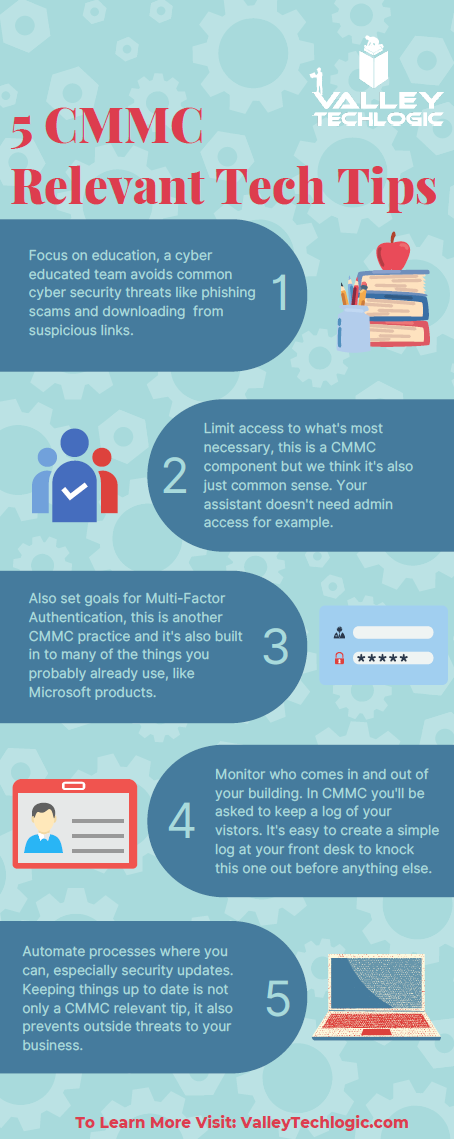
    If you’ve barely scratched the surface in your organization, you can still make changes that will put you in a better position when you begin to tackle it in earnest. Many of the requirements, especially those found in level one, is common sense advice for being safer online. You (and your employees) can work on these five items first:

    If after reviewing the information, you feel like you just need a hand to either cement cybersecurity processes you already have in place or have a partner in your CMMC goals, Valley Techlogic can help.

    We have firsthand knowledge of the CMMC program and helping clients become CMMC certified. Our tools will help you meet the requirements necessary and quickly get your business ready for the audit process.

    Make an appointment today for a free consultation to learn more.

    Looking for more to read? We suggest these other articles from our site.

    This article was powered by Valley Techlogic, an IT service provider in Atwater, CA. You can find more information at https://www.valleytechlogic.com/ or on Facebook at https://www.facebook.com/valleytechlogic/ . Follow us on Twitter at https://x.com/valleytechlogic.

  • Technology that you can build on, supporting your construction business through tech

    Technology that you can build on, supporting your construction business through tech

    We’re continuing from last week where we touched on how technology integrates with the field of dentistry, we want to switch gears from a business sector that helps us maintain our tooth structure to one that helps us maintain our societal structure. We’re looking at how technology can help those in the construction.

    Our construction clients are used to taking on big projects and creating comprehensive plans for tackling those projects with their teams. They aren’t always nailed down to one location, being out in the field and having employees logging in from remote offsite locations is part of their norm.

    Documentation is important for the work they do. They often have a dedicated server that keeps track of all the reports that come with having a construction business. Planning data, financials, insurance information – all of that must be available at a click of a button so they can run their business as smoothly as possible.

    If you’re in construction, ask yourself if any of these tech related items would be applicable to your business:

    1. Slow or non-existent internet on work sites. As we mentioned above, your employees aren’t logging in from one location, they go where the work is that day. You need support for your connectivity that’s flexible for the way you do business.
    2. Equipment that goes “missing”. Like us, you have expensive equipment that needs monitoring and logging. Our construction clients need solutions for making sure their equipment doesn’t “walk off” the job site. Security cameras solutions with the ability to save and review the data they collect are crucial for these clients.
    3. Regulatory compliance concerns. If you work in the government sector (or would like to) you’re probably aware of the ongoing attempt to secure our national data through CMMC (Cybersecurity Maturity Model Certification).

      There’s also the documentation you must do for every portion of your business, because if something goes wrong you need that documentation to back you up. If your documentation goes missing or can’t be retrieved because an outdated server has “malfunctioned”, or your backup solution was inadequate – it can spell trouble for your business.

    The long and short of it is, having a technology solution that supports your business is as crucial as having supports structures in a building to keep it from collapsing. A pillar may not look like much on it’s own but it could be the only thing keeping back a catastrophic collapse.

    At Valley Techlogic, we see ourselves as the pillar that not only keeps your technology equipment running as it should, but also keeps out any intrusions to your business (17.7% of all cyber attacks are aimed at your business model which is second only to the financial sector).

    Here is a chart with 5 ways Valley Techlogic specifically supports our construction clients:

    5 Ways VTL Supports Your Construction Business

    Still on the fence? Why not have a conversation with us directly, book a quick consultation with us here.

    Looking for more to read? We suggest these other articles from our site.

    This article was powered by Valley TechLogic, an IT service provider in Atwater, CA. You can find more information at https://www.valleytechlogic.com/ or on Facebook at https://www.facebook.com/valleytechlogic/ . Follow us on Twitter at https://x.com/valleytechlogic.

  • Our Five Best FREE Resources Ranked

    Our Five Best FREE Resources Ranked

    At Valley Techlogic we believe educating our community on internet safety and providing concrete goals for businesses in our area to help improve their cybersecurity measures whether or not they’re covered by a Valley Techlogic plan is a valuable resource our company can provide to make us all a little safer online.

    We’ve provided quite a few free resources and reports over the years, and we couldn’t help but notice which ones really have struck a cord with our audience.

    Here are our top five free resources and reports, ranked by popularity. Bonus, you can grab all of these right from this page, still absolutely free.?

    #5 The Data Contingency Planning Report

    Our Data Contingency Report tells you EXACTLY what you need to have a solid plan for backing up your business’s files. Click to grab the report now instantly.

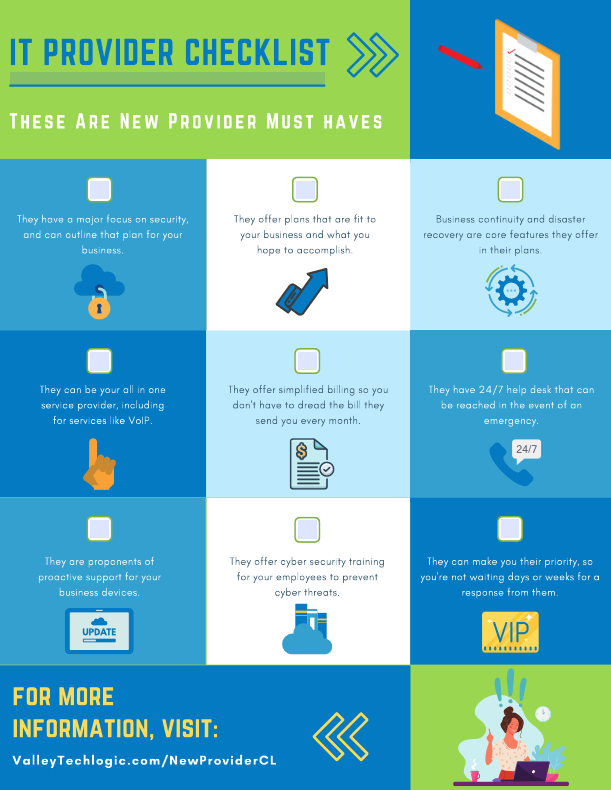
    #4 The New IT Provider Checklist

    Our New IT Provider Checklist lets you check off the MUST have for your new IT provider. If they don’t cover one or more of these items, you should keep looking.

    #3 Our Section 179 Guide

    Our Section 179 helps you get the best tax benefits from the tech purchases you make for your business. We’ll have the updated 2022 version available later this year.

    #2 Our Cyber Security Framework Overview Report

    Our Cyber Security Framework Overview Report goes over in plain text a number of popular frameworks, CMMC, HIPAA and more.

    #1 Our Cyber Security Checklist

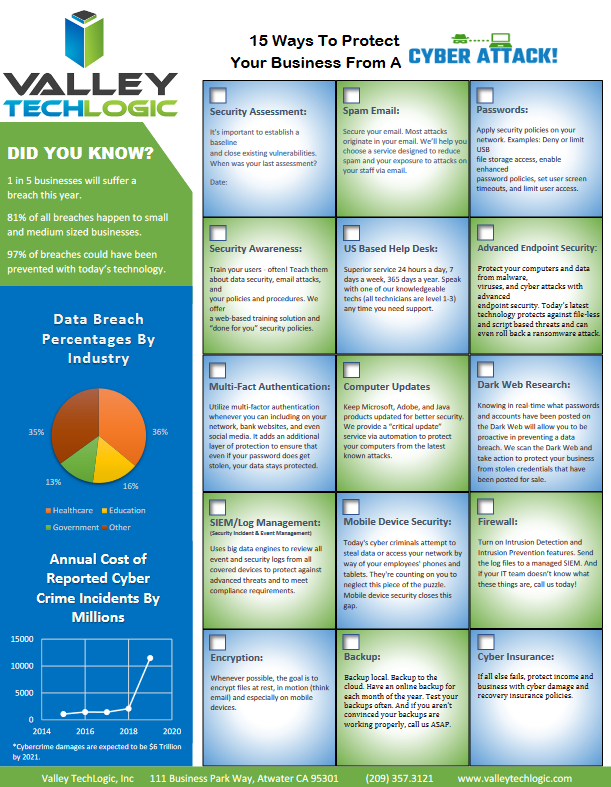
    By far our most popular resource, this no nonsense checklist gets straight to the point on what you need to be fully covered from cyber threats.

    To receive these resources and more, reach out to us to be added to our mailing list. That way you’ll be the first to receive tech tips, free reports and resources and more.

    Looking for more to read? We suggest these other articles from our site.

    This article was powered by Valley TechLogic, IT service provider in Atwater, CA. You can find more information at https://www.valleytechlogic.com/ or on Facebook at https://www.facebook.com/valleytechlogic/ . Follow us on Twitter at https://x.com/valleytechlogic.

  • CMMC Series: The Consequences for CMMC Non-Compliance

    CMMC Series: The Consequences for CMMC Non-Compliance

    You may have thought we finished our series on the Cybersecurity Maturity Model Certification (CMMC) program, but we would be remiss if we didn’t cover the consequences and penalties for not complying with the program if you’re a current Department of Defense (DoD) contractor.

    You may be thinking there’s a window to wait and see while rulings proceed on version 2.0 or have seen dates such as 2025 thrown out as the goal post for when the program will be completely finalized. Or maybe you’re just hoping the whole thing goes away, we get it. Looking at all of the controls and tiers can be overwhelming if your business is new to implementing cybersecurity measures.

    However, the program is here to stay, and your business will be much better equipped to meet the requirements if you begin working on them now. There is a waiting list already for those wishing to obtain their certification earlier, and we expect the wait times to only grow as nearly 40,000 businesses who must comply with this program rush to get their certification before losing eligibility for existing contracts.

    Beyond existing contracts, having your CMMC certification will make your business more competitive when seeking new contracts with the DoD. Progress towards CMMC is an investment in your business’s future, and it also meet the goals of the program which is protecting businesses from cyber threats.

    So, what are the consequences for not working on CMMC compliance now, or in the future?

    The DoD has said that all Defense Industrial Base (DIB) contractors must be compliant by 2025. There are no direct monetary penalties or fines for not being compliant at this time, however your business will no longer be eligible for defense contracts if you have not successfully completed your accreditation by that date.

    Three years may seem like a long time but when you look at the scope of what’s necessary to be compliant with CMMC, it’s really a short window to get your ducks in a row. Tier one could be accomplished relatively easily by most businesses, but if your business handles any Confidential Unclassified Information, you’re really looking at a goal of tier three moving forward (or tier two if/when version 2.0 is released).

    That’s also not counting the time spent in a waiting list for a member of the CMMC Accreditation Body to actually complete your assessment, you will need to work on your self-assessment status and POAM (Plan of Action and Milestones) prior to getting on the waiting list for CMMC accreditation.

    It’s also important to note that your self-assessment must be confirmed by company leadership, it’s not enough to simply have your IT person or team complete the self-assessment and submit it.

    The DoD has said they will randomly test contractor compliance and see if it matches what the contractor has inputted into Supplier Performance Risk System (SPRS). SPRS is a necessary requirement for being compliant with Defense Federal Acquisition Regulation Supplement (DFARS) which many contractors may already be aware of. They will be looking to see if your disclosures for DFARS in regards to CMMC/NIST match.

    Submitting false information could make your business at risk for running afoul of the False Claims Act (FCA), which could leave you liable for civil fines and penalties. There is even a program in place to reward whistleblowers who bring to light businesses who are falsifying information about their cybersecurity practices on these forms.

    This is all so much to say as there are significant risks involved with ignoring CMMC and we suggest you begin working on it now or we’re afraid you’ll be paying for it later.

    If you need assistance with working on your CMMC accreditation, cybersecurity practices and compliance, DFARS forms or more – Valley Techlogic can assist you. Schedule a consultation today to learn how we can help your business meet your CMMC compliance goals for 2022.

    VTL Can Help With Your CMMC Progress!

    Looking for more to read? We suggest these other articles from our site.

    This article was powered by Valley TechLogic, IT service provider in Atwater, CA. You can find more information at https://www.valleytechlogic.com/ or on Facebook at https://www.facebook.com/valleytechlogic/ . Follow us on Twitter at https://x.com/valleytechlogic.

  • CMMC Series: Preparing for your assessment

    CMMC Series: Preparing for your assessment

    This is our fifth article on this topic and as we bring it to a close, I’d like to first look back at what we’ve covered so far.

    We started the series looking at what’s ahead for the Cybersecurity Maturity Model Certification (CMMC) program in 2022. Then we covered tiers one, two and three as they exist in the current 1.0 model of the program. We’re anticipating that tiers two and three will be merged going forward as version 2.0 rolls out (placing a larger burden on defense contractors looking to scale past the beginner controls in tier one and become more competitive in the marketplace).

    So, if you’re reading this you’ve hopefully begun the process of implementing the controls within your business and are thinking it’s time to begin the process of obtaining your certification. There are several steps that come before actually obtaining your certification (although it should be noted that the CMMC Accreditation Body is currently in the process of hiring and waiting lists for certification could be lengthy at this time). The sooner you begin implementing the CMMC controls within your business, the sooner you can attempt to get on the waiting list to receive your certification.

    The assessment process will follow these steps:

    1. You will need to begin implementing a plan for CMMC within your business, and conduct a self-assessment against the NIST 800-171 (or partner with a provider like Valley Techlogic to assist you with this).
    2. As you improve your processes you can submit your score to the Department of Defenses’ (DoD) Supplier Performance Risk System (SPRS).
    3. From there you will need to identify the scope you wish to obtain for your business (it’s our opinion maturity level 3 will be required for most defense contractors in the future).
    4. Obtain a third-party gap assessment, this will show you where your business is and where it needs to be to achieve your goals.
    5. After addressing the gaps found in the assessment, you can look to the CMMC Accreditation Marketplace and choose a CMMC Third-Party Assessment Organization (C3PAO) to conduct your CMMC assessment.
    6. The CMMC Accreditation Body will review the assessment submitted by your C3PAO and award you your CMMC certification.

    Of course, this is boiling down many months (or even years) of preparation into what looks like 6 easy steps.  The process will be time consuming and potentially costly, but for those who wish to continue doing business with the DoD it’s a necessary investment in the future.

    As we’ve mentioned in past articles on the topic, defense contractors who refuse to comply with the CMMC process will no longer be eligible for defense contracts in the future. Beyond that, if you reach a higher level of certification, you will be in a better position to receive more contracts as it will be used as a comparative tool going forward.

    If you’re like assistance with the CMMC self-assessment process or preparing for your CMMC AB assessment, Valley Techlogic has experience in this area. We have helped businesses begin the process of becoming CMMC ready, if you’d like to learn more schedule a consultation with our experts today.

    Looking for more to read? We suggest these other articles from our site.

    This article was powered by Valley TechLogic, IT service provider in Atwater, CA. You can find more information at https://www.valleytechlogic.com/ or on Facebook at https://www.facebook.com/valleytechlogic/ . Follow us on Twitter at https://x.com/valleytechlogic.

  • Cyber Insurance – What you can do to ensure your business will be covered in 2022

    Cyber Insurance – What you can do to ensure your business will be covered in 2022

    Last month we released our new cyber insurance report which is an in depth look into this topic, but we wanted to touch on what we’re specifically seeing so far in 2022 in today’s article because from what we’re seeing in from our clients and in the industry – cyber insurance requirements are on the rise.

    If you’re new to cyber insurance or aren’t sure what’s covered under this sort of policy, for most insurance providers cyber insurance offers coverage for technology related disasters. This could include a cybersecurity event such as ransomware or a data breach but depending on your level of policy it might also include IT related downtime not related to cybersecurity such as internet outages. You may even see coverage for specific device issues, such as the loss of an office server that’s critical for day-to-day operations.

    When it comes to the cybersecurity related coverage what many people don’t realize is it’s not only meant for covering your own losses, but also the potential loss incurred by your customers. If you have a data breach, your cyber insurance coverage will cover the cost of any litigation brought by your customers and it may also cover items such as on-going credit monitoring if their PII (personal identifying information) was exposed in the data breach your company suffered.

    It can be easy to feel detached from a loss you haven’t suffered yet. To put some perspective to, it during the Anthem data breach in 2015 when involved 80 million patient records, their costs to notify their customers (which HIPAA regulations stipulate must be done by snail mail) exceeded $40 million in just postage. That’s not even taking into consideration all of the other costs associated with that breach.

    They’re a major corporation, so again it may be difficult to imagine yourself in those shoes, but even for small companies the average costs are as high as $200,000 per breach. Also, if you’re hit with a ransom and think you can just pay it and get out intact, think again. Many times, even if you receive the de-encryption key from the hackers your data may still be lost.

    It’s not surprising that insurance providers are looking at this and wondering how they can alleviate some of the risk they’re taking providing insurance to customers going forward. The requirements are increasing, even for us as a technology provider for businesses we’re seeing longer forms that we’re assisting our customers with when they go to acquire a new cyber insurance policy.

    These longer forms are featuring more difficult questions as well. We have made cybersecurity a staple feature of our plans so our customers are in a good place for obtaining a cyber insurance policy, but the truth is if cybersecurity has been on the back burner for your business, you may have a difficult time in 2022 and beyond finding an insurer that’s willing to cover you.

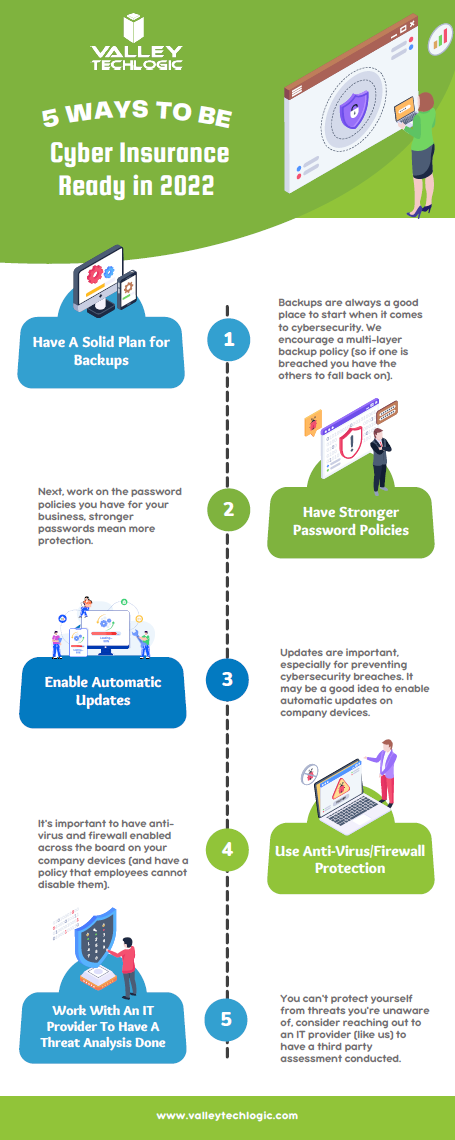
    As an idea of where to start before you go to obtain a cyber insurance policy, we’ve created this checklist of items you can begin to work on to put your business in a better position this year.

    Be Cyber Insurance Ready in 2022
    Click to grab the full size version.

    Many of the items listed are easy for even someone who’s not very tech savvy to tackle, but if you’d really like to protect your business from hackers this year, we suggest teaming up with a tech provider like Valley Techlogic.

    Cybersecurity is a core focus for our business, we will match your business with a cybersecurity framework that makes sense – for example CMMC for defense contractors, HIPAA for healthcare providers, NIST or CIS for small and medium sizes businesses of any industry – and use that framework to have a concrete game plan for making sure your networks and devices are impenetrable to bad actors. Learn more today with a quick consultation

    Looking for more to read? We suggest these other articles from our site.

    This article was powered by Valley TechLogic, IT service provider in Atwater, CA. You can find more information at https://www.valleytechlogic.com/ or on Facebook at https://www.facebook.com/valleytechlogic/ . Follow us on Twitter at https://x.com/valleytechlogic.

  • CMMC Series: Tier Three Overview

    CMMC Series: Tier Three Overview

    We’ve covered tier one and tier two of the Cybersecurity Maturity Model Certification (CMMC) program, and this week we’ll be tackling tier three.

    Before we dive in, we want to mention that we’re covering tier three as it exists currently (in 2022), version 1.0 has five tiers but once version 2.0 of the program releases it will be reduced to three tiers.

    What is currently tiers two and three will just be tier two version 2.0 of CMMC in the future, so it’s still worthwhile to pursue up to tier three in the existing model.

    Tiers four and five in the existing model (or tier three in the future in version 2.0 of CMMC) feature the highest level of protection and may not be necessary for most businesses pursuing Department of Defense (DoD) contracts. It’s estimated less than 1% of businesses will need to pursue beyond tier three.

    If you were to give the first three tiers’ labels, tier one would be considered “basic hygiene”, tier two would be “progressive hygiene” and in tier three you reach “good cyber hygiene”. By tier three your business will be well protected from cyber-attacks.

    Tier one had 17 controls, tier two added 55 more for 72 total, and tier three almost doubles the controls adding another 58 for 130 total.

    Level three expands on Access Control, which adds 8 more controls that focus on encryption and preventing unauthorized access to sensitive systems.

    Next, we see a new control in Asset Management that requests that you develop plans and procedures for handling CUI data.

    Audit and Accountability has 7 new controls that ask you to expand on your logging efforts as well as restrict access to those logs to only authorized users.

    Awareness and Training has one new control and it’s solely around providing and maintaining cyber training for your employees.

    Configuration Management adds three new controls, the CMMC controls in this category are looking for you to tighten up the configurations on your business’s devices, such as preventing downloads of unauthorized software and disallowing users to make security changes on their own.

    In Identification and Authentication we see four controls aimed at tightening up your user security, such as not allowing passwords to be reused and requiring MFA (multi-factor authentication).

    The two controls found in Incident Response ask you to track any incidents that occur and regularly test your organization incident response capabilities.

    Tier three Maintenance adds two new controls, one that asks you to sanitize any equipment of CUI data before it’s removed for maintenance and another that asks you monitor any media meant for testing or diagnostic purposes for malicious code before installing it on your devices.

    Media Protection adds four new controls, they all involve properly marking and restricting access to CUI data.

    Physical Protection in tier three of CMMC adds one control and it asks you to continue expanding on your efforts to prevent physical outside threats to the CUI data your business holds.

    Recovery also adds just one control and it’s aimed at having a schedule for your businesses backups that is strictly maintained and that proper storage capacity for your backups is provided and prioritized.

    Risk Management adds three controls, two are about maintaining risk assessments and developing plans to mitigate any identified risks. The third asks you to manage products not supported by vendors separately, including enforcing access and use restrictions on them. What they mean by this is if your business utilizes an older piece of software you’re not able to discontinue yet – you need to quarantine it to be in compliance with CMMC. Any piece of software not updated is a potential threat vector for your business.

    Security Assessment adds two new controls, they want you to monitor your security controls for ongoing efficacy and also have an independent security assessment conducted to identify any areas of risk that may be missed in your internal efforts.

    Not seen in tiers one or two, tier three introduces the first Situational Awareness control, and it asks that you begin to share cyberthreat intelligence found from reputable sources with your stakeholders. An example would be if there’s been an announcement of a breach occurring with a software your business uses, you would be obligated to share your knowledge of that breach as it becomes available to you.

    System and Communications in tier three adds the most new controls of any category with 15 controls in total. Controls in this category cover items such as ensuring proper information security across your in-house efforts in software engineering and system development to maintaining cryptographic keys for all the cryptography used on your systems. All of the controls are aimed at completing finishing touches when it comes to tightening up the security on your systems.

    Finally, System and Information Integrity adds three new controls. One asks that you beef up your efforts to block spam at all entry points, the second asks that you utilize all available efforts to prevent and detect document forgery and the third asks that you implement “sandboxing” to filter and block potentially malicious emails.

    As you can see, tier three greatly expands on the active role your business will need to take when it comes to cybersecurity measures. Implementing tier three will be made easier though as your business conducts the cumulative process of preparing better cyber readiness.

    For example, in tier two we saw monitoring efforts increase substantially, in tier three you can use the records that have been obtained to fill in the gaps that were uncovered in that process.

    Because such a small portion of businesses will need to obtain tiers four and five, we are not planning to have an in-depth article on those tiers. If you would like to have a consultation with Valley Techlogic on the CMMC process and the maturity level you will need to obtain for your business, you can schedule one here. In next weeks article we’ll talk about the CMMC auditing process and what you’ll need to do to prepare as your audit approaches.

    Looking for more to read? We suggest these other articles from our site.

    This article was powered by Valley TechLogic, IT service provider in Atwater, CA. You can find more information at https://www.valleytechlogic.com/ or on Facebook at https://www.facebook.com/valleytechlogic/ . Follow us on Twitter at https://x.com/valleytechlogic.