Tag: CMMC

  • CMMC Series: Tier Two Overview

    CMMC Series: Tier Two Overview

    This is the third week of our Cybersecurity Maturity Model Certification (CMMC) Series. You can find week one, which was a look at what’s happening with CMMC in 2022 here. Last week, we gave you an overview of tier one which you can review here.

    Tier one in CMMC really covers the basic foundational steps you must take to move on to tier two and tier three. For some contractors, tier one will be enough to keep and maintain compliance with their Department of Defense (DoD) contracts. Every situation is unique, but broadly speaking if you don’t handle Controlled Unclassified Information (CUI) in your business – tier one will probably be the extent that you need to reach.

    If you do handle any CUI data, then we recommend you strive towards tier two or tier three. Many of the protections that come in the later tiers specifically cover how to safeguard this data and it’s in your businesses best interest to meet the requirements. While there are no direct financial penalties at the time of writing for not doing so, the DoD is considering a system of rewarding businesses who achieve greater CMMC maturity levels.

    If you and another business are exactly the same in what you do and, in your pricing, – or even if their pricing is a bit higher than yours – if they have achieved tier three cybersecurity maturity model certification and your business is tier one or not certified at all yet, it’s likely your competitor will win the bid.

    So, what goes into reaching tier two in CMMC?

    Tier two is the next milestone within CMMC, and the difficulty does scale considerably with each level. While tier one had 17 provisions, tier two introduces 55 more for a total of 72 practices you’ll need to cover to meet the requirements (the practices are cumulative).

    In addition to more practices tier two also introduces new domains.

    First there is Access Control, tier two access control looks to limit access to who can log into your organizations systems (and how much they can access when they do).

    Next is Awareness and Training, in tier two you will need to make sure your managers, administrators and anyone else you who would have access to sensitive systems is attending regular cybersecurity training.

    In Audit and Accountability, we look to maintain logs of user activity for review.

    Security Assessment is where we really begin to see accountability being held on organizations, you will need to conduct regular assessments as you work towards your cybersecurity goals and develop cybersecurity plans based on the assessment results.

    Configuration Management covers the need to manage the configurations of your office devices and equipment with cybersecurity best practices in mind.

    Identification and Authentication is similar to access control, but it specifically looks to limit sensitive systems to only those who should have authorization to access them.

    While tier one in CMMC only covered the basics and didn’t address what happens when you have a cyber incident, tier two starts to cover that with the Incident Response control.

    The Maintenance control in tier two actually refers to your devices and how you maintain them, and what you will need to do in case of their failure.

    Media Protection in tier two covers specific provisions around the handling and destruction of removable media, such as flash drives.

    We started looking at Physical Protection in tier one by keeping visitor logs, but tier two asks that you actually begin to escort guests through your facilities and screening personnel.

    Tier one surprisingly doesn’t ask that you backup your data (even though we would always recommend that) – in tier two Recovery you must have a plan for backing up your data.

    In tier two Risk Management, CMMC asks that you begin to conduct risk assessments and fix any vulnerabilities that are uncovered during the process.

    Systems and Communications Protection in tier two includes controlling communications within your organization, not just monitoring them.

    Finally, the System and Information Integrity domain covers actively monitoring your systems for breaches and quickly resolving any that come up.

    As you can see, CMMC maturity tier two dives into the deep end of cybersecurity, but the provisions it covers will make a discernible impact in your cyber readiness throughout your entire business.

    Does your business need to meet the requirements for being certified with CMMC? Valley Techlogic can help, we have experience helping DoD contracted businesses reach their cybersecurity and CMMC goals, as well as helping with the certification process itself. Learn more today in a free consultation.

    Looking for more to read? We suggest these other articles from our site.

    This article was powered by Valley TechLogic, IT service provider in Atwater, CA. You can find more information at https://www.valleytechlogic.com/ or on Facebook at https://www.facebook.com/valleytechlogic/ . Follow us on Twitter at https://x.com/valleytechlogic.
  • CMMC Series: Tier One Overview

    CMMC Series: Tier One Overview

    Last week we covered a general overview of what the Cybersecurity Maturity Model Certification (CMMC) program is and what’s been announced for 2022 so far. Presently, there are five maturity tiers found in program, although if (or when) version 2.0 is released it’s been announced that the program will be simplified down to just three tiers.

    The changes that will be happening with version 2.0 however don’t affect tier one very much. Tier one covers basic cybersecurity hygiene in both versions of the program. It sets the groundwork for the later tiers and while the topics covered are “basic”, the foundational coverage they provide is imperative for any business – not just those required to adhere to CMMC for contractual or compliance reasons.

    The Cybersecurity Maturity Model Certification (CMMC) program includes 17 controls at the moment with 171 practices. Thirty of those practices are only found within CMMC and not in the framework which formed the basis for it (NIST) and are anticipated to be removed in version 2.0. However, in both version 1.0 and 2.0 there are 17 practices that must be adhered to for tier one.

    It’s important to note as well this process is not one and done, you must actively maintain your cybersecurity compliance to continue being certified within CMMC. Failure to do so could result in losing your certification, losing contracts that require CMMC compliance, and or even being fined for violating the False Claims Act (FCA) which will talk about in more detail in a future article.

    It’s beneficial to maintain your compliance to both adhere to the program and protect your business from cyber threats.

    In tier one the program begins with “Access Control” and there are five components. These components cover topics such as user privileges and controlling remote access and access to internal systems.

    The next control is “Identification and Authentication” which aligns well with Access Control, the two practices found within that control involve documenting those that access your systems and maintaining reports for those logins.

    Then we have “Media Protection” which has just one practice and it’s aimed at maintaining sanitation of your devices (such as removing sensitive data from hard drives).

    Next, we have “Physical Protection” and in tier one of CMMC this topic covers improving the way you surprise visitors to your office location (a lot of cyber threats stem from an attack known as “spear phishing”). There are four practices found under “Physical Protection”.

    “System and Communication Protection” has two practices and they’re both aimed at securing the private communication you and your employees have (that may include CUI – Controlled Unclassified Information – data).

    Finally, we have “System and Information Integrity” which has five practices that cover better securing your businesses systems, including performing needed updates, and monitoring for malicious code.

    As you can see, these basic practices set a good baseline for activities found in higher maturity tiers. In tier one “System and Information Integrity” you’re monitoring for malicious code – in tier two and three there are practices that stipulate how to actually deal with it.

    We will be continuing to provide more information on CMMC in this series, next week we will take an in depth look at tier two. If your business needs to meet the requirements for being CMMC certified, Valley Techlogic can help. We have experiences helping businesses achieve greater cybersecurity compliance and assisting them with the certification process. Learn more today.

    Looking for more to read? We suggest these other articles from our site.

    This article was powered by Valley TechLogic, IT service provider in Atwater, CA. You can find more information at https://www.valleytechlogic.com/ or on Facebook at https://www.facebook.com/valleytechlogic/ . Follow us on Twitter at https://x.com/valleytechlogic.
  • CMMC Series: What’s Happening in 2022

    CMMC Series: What’s Happening in 2022

    We’ve touched on the Cybersecurity Maturity Model Certification (CMMC) before in this blog, but over the next five weeks we’ll be doing a deep dive into this particular cybersecurity framework in our new CMMC Series. Starting with today’s post on what’s happening currently and what we can expect in 2022.

    At Valley Techlogic, we believe a good cybersecurity framework can be the backbone for businesses looking to beef up their cybersecurity implementation. The roadmaps found within frameworks such as CMMC, HIPAA, CIS and NIST act as a perfect guide whether you’ve been implementing cybersecurity strategies for a while or are brand new to the process.

    Our focus on CMMC occurs as the program is set to go through changes. CMMC Version 1.0 was released January 31st, 2020, and while it borrowed most of its components from NIST, it did have 30 additional requirements that aren’t found in the National Institute of Standards and Technology (NIST) framework.

    Those additional standards will not exist in version 2.0 however, as the Department of Defense (DoD) moves to simplify the program and roll back any government oversight that may overreaching. Version 2.0 will allow more companies to self-certify as well.

    Rolling out a new version of anything in the government is a time intensive process, since the new changes were announced it’s anticipated it could take anywhere from 9 months to 24 months before a ruling is established. Also, some groups who are currently involved in implementing CMMC are protesting the changes.

    Regardless of what version exists, we’re past the point where businesses who hold contracts with the DoD can choose to ignore the writing on the wall. You will need to start implementing these security measures now if you haven’t already if you want to maintain your compliance with the DoD rules for their contractors. Whether 2.0 passes or not, CMMC is not going away.

    CMMC accreditation audits are expected to kick off soon, and there’s even some talks about incentivizing businesses who receive their CMMC certifications before it’s officially required. CMMC certification also lets your customers know you take securing their data seriously within your organization.

    Whether it’s 5 tiers found in the existing model or 3 tiers found in 2.0, the best place to start is in the first tier. These changes are easy to quickly implement and will lay the foundation for future cybersecurity improvements. At Valley Techlogic, we have experience helping businesses implement the requirements found within CMMC (as well as NIST, HIPAA, CIS and more).

    We can help your business self-certify and prepare for CMMC accreditation. We can quickly bring you to compliance with tier one and set goals for the more advanced levels.

    Over the next weeks we will talk about the goals found within tier one and beyond in this ongoing CMMC series. If you’re hoping to meet the qualifications for CMMC accreditation in 2022, schedule a meeting with us today to learn how we can help with the process.

    Looking for more to read? We suggest these other articles from our site.

    This article was powered by Valley TechLogic, IT service provider in Atwater, CA. You can find more information at https://www.valleytechlogic.com/ or on Facebook at https://www.facebook.com/valleytechlogic/ . Follow us on Twitter at https://x.com/valleytechlogic.
  • Cybersecurity Maturity Model Certification 2.0 has been announced, what it means for you and your business

    Cybersecurity Maturity Model Certification 2.0 has been announced, what it means for you and your business

    If you’re a contractor or subcontractor for the Department of Defense (DoD) you probably at least have an awareness of the evolving situation surrounding the CMMC (Cybersecurity Maturity Model Certification) program, or maybe you’ve even begun the self-assessment process.

    Announced summer of 2019, version 1.0 was released January 31st, 2020, and a 5 year roll out was planned to get DoD contractors and subcontractors compliant with the framework. The framework is based on the security controls found in the National Institute of Standards and Technology (“NIST”) Special Publication (“SP”) 800-171, with many of the security controls found in CMMC having a direct correlation to a control found in NIST 800-171.

    While the initial CMMC framework was aimed at bringing defense contractors up to speed in their cybersecurity efforts to protect critical Controlled Unclassified Information (CUI), the use of the broad term CUI instead of the defense specific Covered Defense Information (CDI) phrase may indicate that this framework will extend beyond just defense contractors in the future.

    The controls found in NIST are applicable to businesses of all sizes and in all sectors so following the CMMC or NIST frameworks whether or not you’re defense contractor/subcontractor will mean your business will be well protected and compliant with rules and regulations set by your vendors, clients, and services for your business such as cybersecurity insurance.

    In it’s original iteration there were 5 maturity levels found in CMMC, with levels 1-3 really closely following NIST and 4-5 going beyond the scope of what NIST covers. They were described as “maturity levels” as they were meant to measure the maturity of the cybersecurity practices found within your organization.

    For most defense contractors, reaching level 3 of CMMC would be an ideal goal. Levels 4 and 5 covered practices outside the scope of most business’s and would require more specialized (and expensive) security practices. Even in version one of CMMC contractors were allowed to self-certify for maturity level 1, but beyond that would require outside certification. The waiting list to receive that certification is long, so planning to implement the required cybersecurity measures and getting on the waiting list to be certified ASAP is a good idea.

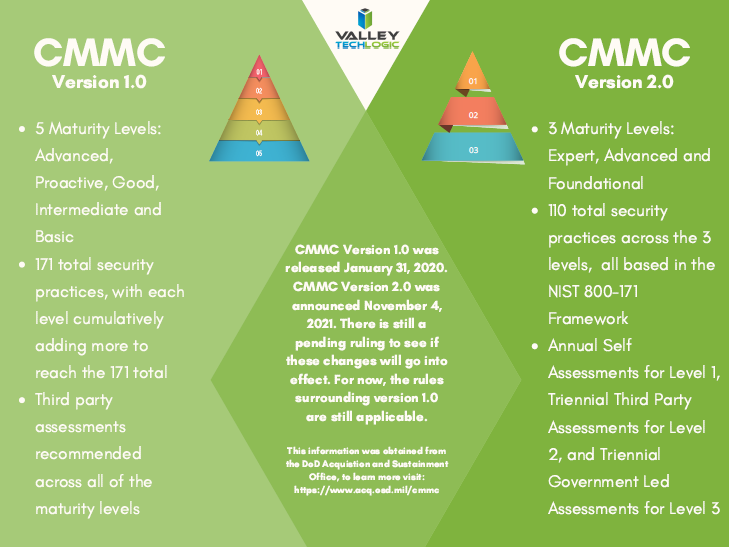
    Now, as of November 4th the DoD has announced an update to CMMC. Version 2 may be removing two of the levels and some of the security measures that were unique to CMMC framework, making the framework match NIST even more closely. Below is the chart we have created with the outlined changes as we know them and as of this posting.

    CMMC Version 1 and 2 Chart
    Click to view the full size.

    This is an evolving situation and as the rollout progresses it’s imperative that businesses that receive DoD contracts begin or continue to increase their efforts in becoming CMMC certified, which may mean drastically increasing your cybersecurity efforts across the board.

    Valley Techlogic has experience in helping businesses meet the goals found within the CMMC framework and we’re ready to help your business meet your certification and cybersecurity goals today. Click here to schedule a quick consultation to find out more.

    Looking for more to read? We suggest these other articles from our site.

    This article was powered by Valley TechLogic, adns, n IT service provider in Atwater, CA. You can find more information at https://www.valleytechlogic.com/ or on Facebook at https://www.facebook.com/valleytechlogic/ . Follow us on Twitter at https://x.com/valleytechlogic.

  • How much are you worth on the Dark Web?

    How much are you worth on the Dark Web?

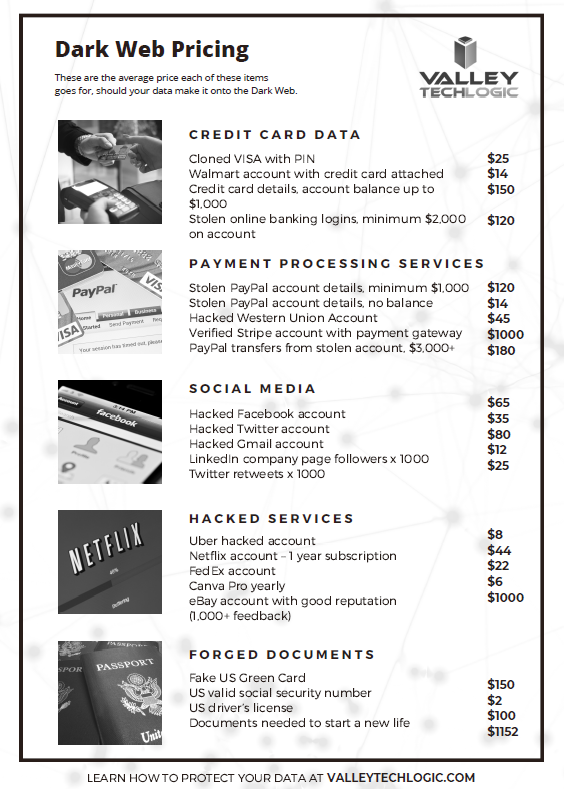
    Not you specifically, but the data that makes up your online activities and private details? What about your various web accounts, for example did you know a hacked Netflix account with 12 months of service is worth $44 on the Dark Web as of 2021?

    We know the Dark Web is a nebulous concept and most of the people we talk to really don’t feel as though it has much to do with them. There’s even those that have resigned themselves to the fact their data is just “out there”, but take solace that in the flux of so many people who experience identify theft (1, 387, 615 reported cases in 2020) there’s just no way a hacker would ever reach them personally.

    If you’re a business owner this is of course, a crock of baloney. While there are many business owners in the US, their numbers pale in comparison to the vast swafts of people who don’t own a business and thereby don’t have valuable employee and financial data within their purview. The fact is by simply owning a business, you’re more vulnerable to being a target of identity theft.

    Business identity theft and consumer identity theft typically occur with the same goal in mind, financial gain for the bad actor. However, business identity theft carries a much larger trickle-down effect. It’s not only your own data that’s at risk, there’s also that of your employees and your business itself.

    Business size doesn’t affect the rate at which you’ll be targeted either, in fact during the COVID pandemic, business identity theft soared across the board.

    This all leads us back to what hackers hope to gain and what your financial data and other pertinent details and accounts are really worth on the dark web, we’ve created this chart with some notable items, but you can find the whole list for 2021 here:

    Click to grab the full size version.

    As the website above states, the quantity of these items found on the dark web also has grown considerably in the last year. It’s predicted cyber theft will cost the world $10.5 trillion annually by 2025. Cyber crime is more profitable than the global drug trade at this point in time.

    So instead of thinking “it won’t happen to me” you should begin considering what you will do when it does happen to you, or even better – what you can do to stop it.

    For instance, at Valley Techlogic we provide all of our customers with Dark Web Monitoring as a routine part of their services with us.

    Dark web monitoring won’t stop your details from being leaked but it will help you monitor and prevent further damage. If your credentials are made available to hackers and you’re aware of it, it’s a lot easier to change them ahead of any damage being done to your accounts and systems.

    You can also partner with an IT provider who has a cyber security stack that exceeds what you could procure on your own. This allows you to take advantage of a robust cyber security package without trying to manage and absorb the cost yourself, allowing you to protect your business and even save money.

    Finally, your provider can help you comply with a cybersecurity framework recommended by the US government, such as NIST or CMMC. This will offer you the best most comprehensive protection from business identity theft.

    Valley Techlogic can assist you with all of these recommended cybersecurity practices. Learn more by taking a quick 10 minute discovery call with one of our tech experts.

    Looking for more to read? We suggest these other articles from our site.

    This article was powered by Valley TechLogic, an IT service provider in Atwater, CA. You can find more information at https://www.valleytechlogic.com/ or on Facebook at https://www.facebook.com/valleytechlogic/ . Follow us on Twitter at https://x.com/valleytechlogic.