
Tag: cyber security training

  • 5 of the Most Important Cybersecurity Training Topics to Cover with Your Employees

    5 of the Most Important Cybersecurity Training Topics to Cover with Your Employees

    We’ve discussed cybersecurity training before and its importance in preventing the number 1 cause of cybersecurity disasters – human error.

    We offer cybersecurity training as a core feature in our tech care plans, but many topics you can (and should) cover yourself with your employees. There couple be rules that specifically apply to your business sector; like HIPAA for healthcare or CMMC for Department of Defense contractors.

    Maybe you’ve experienced a cybersecurity attack before and after the dust settled you came up with a game plan specifically to prevent it from happening again. If it hasn’t happened to you yet, it’s a mistake to assume it never will. In 2021 42% of businesses experienced a cyberattack. It’s a numbers game most won’t win without preventions in place.

    To start, we want to offer these posters we’ve created on two common cybersecurity threat topics, email and malicious attachments. These posters are free for you to print and brand to use in your office or send as a reminder, and these are two excellent places to start when you’re looking to beef up your office security.
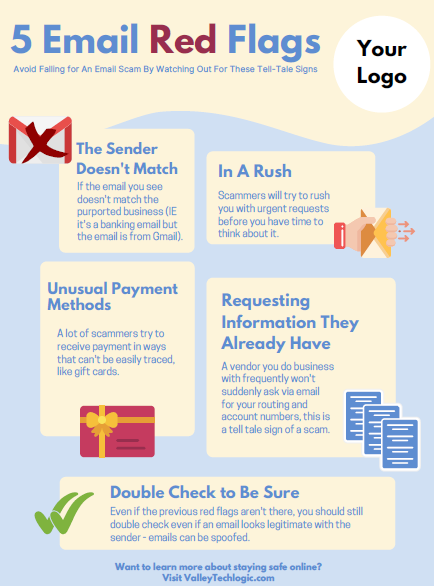
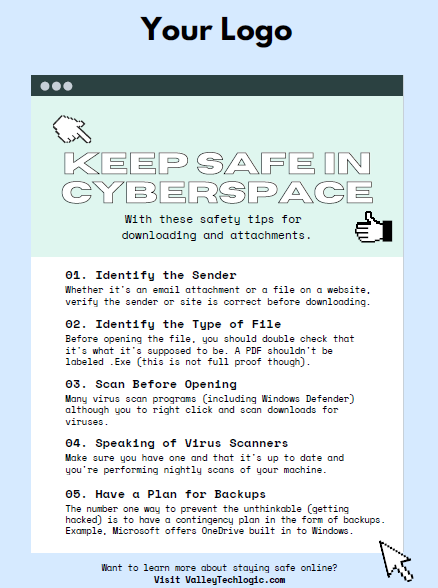
    Click to grab the full size version.
    Click to grab the full size version.

    Here are five more training topics all workplaces should also cover:

    1. Like our posters above, email security and having strict guidelines for attachments and downloads is one key thing to focus on in your cybersecurity training efforts.
    2. It’s also important to provide guidance for internet usage while at work. Many employers try to digitally lock this down, but these efforts are usually met with annoyance and disdain from employees and are often in vain. Instead of arbitrarily trying to block everything with software we suggest having guidance about what’s appropriate for work devices (and what Isn’t). We also suggest noting that even if a website looks legitimate it may not be, so they should be wary of sites that ask you to download something or enter private credentials.
    3. This comes to the next topic which is practicing good safety hygiene with work devices. Three easy steps are: Locking your computer when you walk away, only downloading software from work authorized sites, and keeping your device up to date with patching and software updates. They may need assistance with the third step so it’s a good idea to have your IT provider manage workstations if you’re able to (this is something Valley Techlogic providers for all clients).
    4. The fourth step is protecting company data. If you’re employees have to interact with documents that are confidential in nature you should have rules for the sharing of those documents, as well as a comprehensive plan for backing them up safety.
    5. Finally, you should provide guidance on passwords and multi-factor authentication. Having a rule in your workplace that for work accounts they must have multi-factor enabled (or have your IT team enable it across the board) will drastically improve your office’s online safety. We have guidance for this topic here.

    It can feel overwhelming to have all of these topics to cover with your employees, but we cannot overstate how important it is to cover these topics with your employees, even if you think they’re things they should already “know”.

    At Valley Techlogic we have partnered with a platform that not only provides cybersecurity training resources, but it also allows you the ability to create your own training modules. You can even cover topics that fall outside the cybersecurity spectrum. We can also work with your business to assist you in the creation of these training modules, if you would like to learn more schedule a consultation with our sales manager Annette today!

    Looking for more to read? We suggest these other articles from our site.

    This article was powered by Valley Techlogic, an IT service provider in Atwater, CA. You can find more information at https://www.valleytechlogic.com/ or on Facebook at https://www.facebook.com/valleytechlogic/ . Follow us on Twitter at https://x.com/valleytechlogic.

  • October is National CyberSecurity Awareness Month, Our Checklist Will Get You Started

    October is National CyberSecurity Awareness Month, Our Checklist Will Get You Started

    Every October the CyberSecurity & Infrastructure Security Agency (CISA) releases a list of resources and tips for National CyberSecurity Awareness Month – which is now in its 18th year.

    This year’s theme is “Do Your Part. #BeCyberSmart”. There has been an onslaught of news worthy ransomware attacks, DDoS attacks and data breaches (up 38% this year compared to last) in 2021 and there has never been a better time to address what the average person or business can do so they don’t end up as part of these statistics.

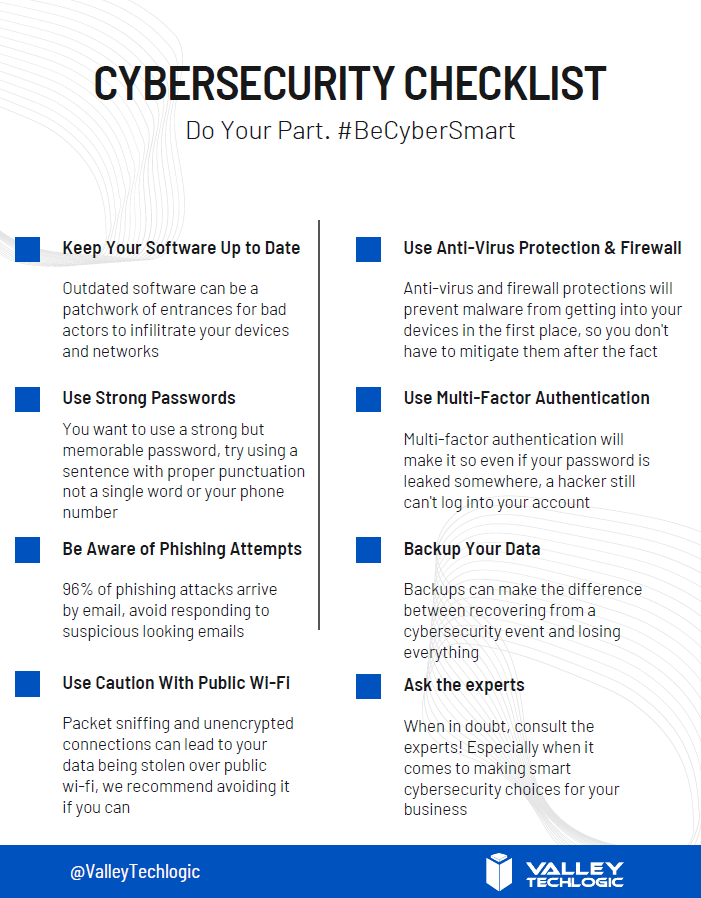
    We’ve created this checklist so you can see if you’re following the right path to keep your business safe from outside intruders.

    Click to download the online capable version.

    Cybersecurity requires ongoing maintenance to succeed. Following simple safety steps will help but it’s important not to disregard active threats to your business from the outside.

    Ongoing employee training is one way to combat those threats, cybersecurity training has evolved to include bite size doses of good advice for your employees that could make the difference between inadvertently falling for a phishing scam or attack attempt and reporting it to your IT team as they should. 95% of data breaches involve human error.

    It can also be important to have a team behind you making sure all of your company devices are maintained and updated, even if that outdated Windows 7 computer that sits in a corner is barely used it can still be a threat to your business. Older devices with outdated software can act as a gateway to allow bad actors into your business.

    More advanced maintenance such as enabling two-factor or multi-factor authentication on company accounts can be another important step to keeping threats out. If someone gets your password from another company’s data breach (which happens all the time) that phone pop up could prevent you from being hacked.

    Finally, having a comprehensive backup program for your businesses data is the final shield against cyber threats. We’re unique in that we offer not only active backups but archival backups as well. The archival backup is “Write once, Read many” which means you can look at the data as often as you like but it can’t be edited or deleted.

    A bad actor may find your unbacked up data, and they may gain access to your active backups, but that archival data is virtually bullet proof. For your important files, the ones that must not be deleted at any cost, having that backup there and ready if you need it is the peace of mind most of us would not want to be without (learn more about our backup program here).

    If this article has gotten you thinking about what you can do to improve your cybersecurity processes or even that you need to create a plan to get there, we’d love to help. Schedule a discovery call with us to learn more about how Valley Techlogic can help you be #CyberSmart.

    Looking for more to read? We suggest these other articles from our site.

    This article was powered by Valley TechLogic, adns, n IT service provider in Atwater, CA. You can find more information at https://www.valleytechlogic.com/ or on Facebook at https://www.facebook.com/valleytechlogic/ . Follow us on Twitter at https://x.com/valleytechlogic.

  • Cyber Security Training Is More Accessible Than You Think

    Cyber Security Training Is More Accessible Than You Think

    It can be a hard pitch getting your employees to commit to cyber security training, and you yourself may wonder if it’s worth the time spent on it.

    It’s a simple fact, when it comes to cyber security breaches humans are the weakest link. There is no software measure that can preempt the human element when it comes to bad actors getting into your business’s systems and accessing your sensitive data.

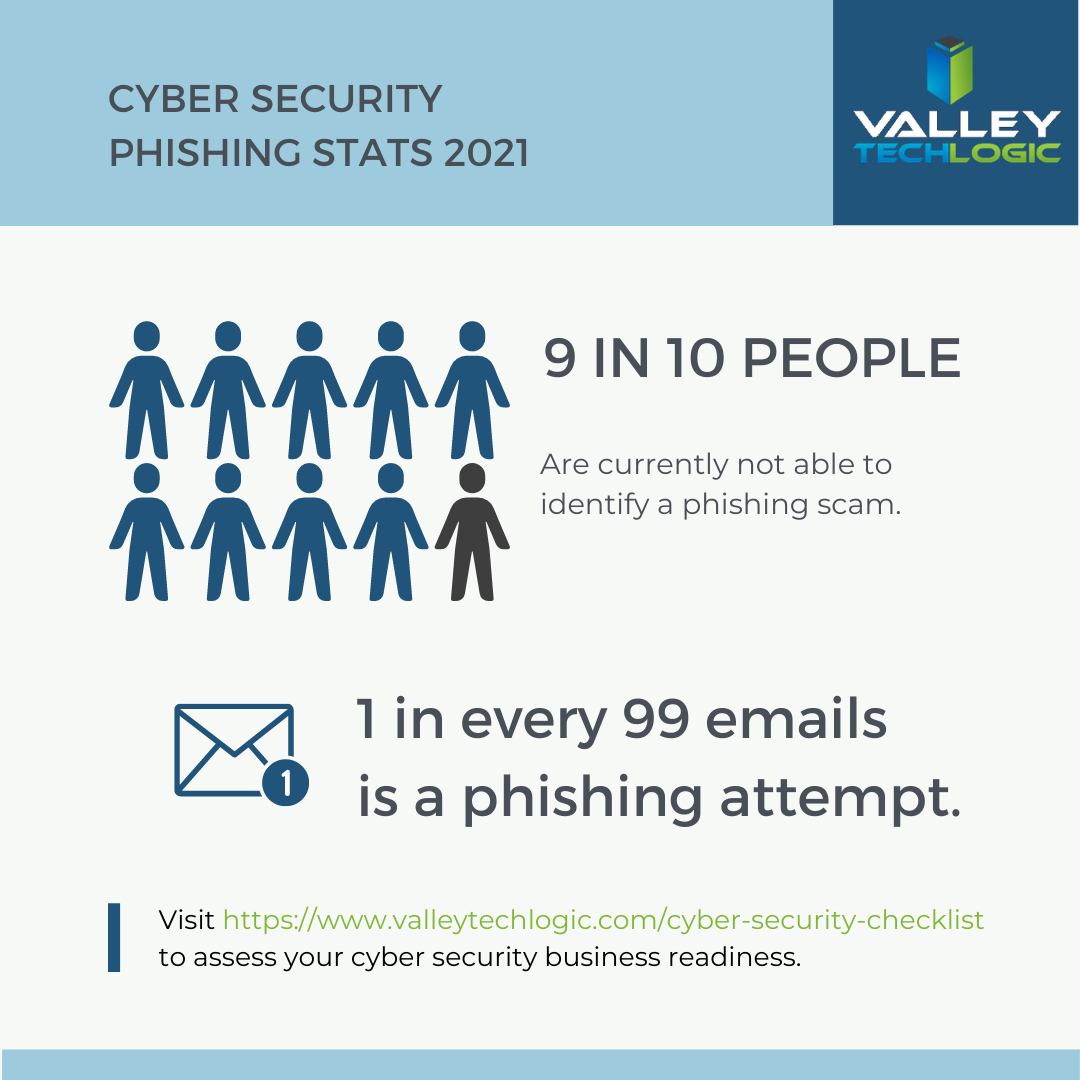
    It’s not your employees’ fault, hackers are constantly devising new ways to breach your systems. They spend countless hours on it and they’re very, very good at it. Just look at these eye-opening statistics.

    Statistics on Phishing

    When many people think cyber security training, they think of something they’ll have to spend hours on. Long form videos with wordy explanations in tech-speak that doesn’t resonate or get absorbed by the intended audience.

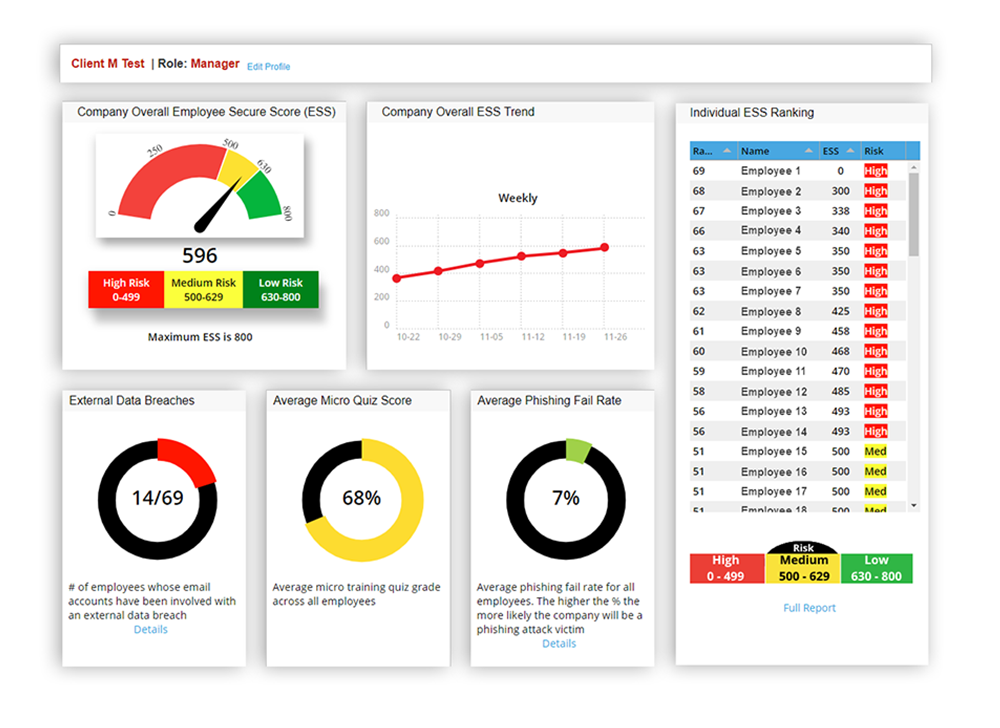
    However, cyber security training has come a long way past that. Like most of our internet consumption activities, it can be delivered in quick bites that drive the point home in a way that speaks to your employees and many offer micro quizzes that quickly evaluate whether the information provided was understood.

    The systems we have used have management and owner portals so you can continuously monitor the results of these quizzes as well as the results of simulated phishing exercises.

    Web Training Portal

    Phishing remains a top threat to companies across the country, of breaches that have occurred in 2021, 22% involved phishing (45% involved hacking and 17% involved malware).

    Simulated phishing exercises allow you to randomly test your employees in a safe environment. The results are confidential and if you find this is a regular problem with your organization it lets you know you need to step up your efforts in regard to email safety training and have more stringent policies in place.

    There is even cyber security training that can be delivered directly via your email client, the short form videos will appear on the right-hand side and the micro quizzes can be taken immediately after viewing. making it highly accessible since there’s no need to navigate to a website.

    An additional benefit is you can inform your clients and vendors that you are conducting cyber security training within your organization.

    Also, if you access cyber security training through your IT service provider it can be highly affordable or even free. At Valley Techlogic we believe in the benefit of not only providing IT and support and service to our clients, but also making tools and information available to allow them to be completely informed in their IT choices. This includes offering cyber security training as an option for the businesses we provide services for.

    Cyber security is best implemented through a package effort of passive prevention and active prevention, passive prevention is the software we employ that prevents and mitigates cyber security threats. Active prevention is the training we offer that allows  employees to safeguard their own systems and prevents potential threats from occurring at all.

    If you’d like more information on cyber security training and/or other cyber security prevention services, you can reach out to us here. We also offer a free cyber security training kit you can get started with here.

    Looking for more to read? We suggest these tech articles from the last week.

    This article was powered by Valley TechLogic, an IT provider in Atwater, CA. You can find more information at https://www.valleytechlogic.com/ or on Facebook at https://www.facebook.com/valleytechlogic/ . Follow us on Twitter at https://x.com/valleytechlogic.
  • Business Email Compromise (BEC) and Phishing – How Do You Combat It?

    Business Email Compromise (BEC) and Phishing – How Do You Combat It?

    Business email compromise (BEC) and phishing are not new ways to scam, as soon as email rose to popularity as a dominant form of communications scammers saw a lucrative window and took advantage.

    Before we explain how to avoid it we should explain what Business Email Compromise (BEC) is. BEC is when a legitimate business is sent an email that looks like it’s coming from another legitimate business, but it’s not. It’s actually a scammer spoofing that email identity. This is the most popular form of phishing but it’s far from the only version. Scammers can even spoof your own domain, so an email looks like it’s coming from within your own organization.

    How do you combat something so insidious? The top way is training, by training yourself and your employees properly on what to look for then you can avoid these scams which cost people located in the US $57 million last year.

    Here are some of the things we look for when determining is an email is a phishing attempt.

    1. It may contain a generic greeting such as “Hello sir or madam” or “Hi Dear” a company you do business with or a person you know would probably know your name.
    2. The email mentions some kind of fraudulent activity on your account and has a link asking you to confirm your private details to unlock or otherwise reinstate your account. This is a VERY common scam.
    3. The links in the email are NOT from the business the email is purporting to be when you hover over them.
    4. The email may contain spelling errors and sentences that sound strange grammatically.
    5. The logos in the email may be of a poor resolution because these scammers do not have access to the real company assets.
    6. The email is coming from a CEO or President of a large organization and is asking you to wire money in exchange for a lump sum in return later. These emails may not have spelling errors or strange links but ask yourself – would any CEO or President of a large company be asking you to wire them money?

    That last one is key, if all the obvious methods of detection fail you may have to rely on just asking yourself if the request in the email makes sense. If the email looks like it is coming from someone you know personally, reach out to them via phone or in person to ask about it. Most of the time, victims who have had their emails compromised or spoofed have no idea it’s even going on.

    Beyond training on knowing what to look for in a phishing email these are our top 3 things to protect yourself from scams across the board.

    1. Keep the software on your devices completely up to date.
    2. Use Multi-factor or 2 Factor Authentication on your accounts.
    3. Backup your data regularly so on the off chance something happens, you’re covered.

    If you receive an email you suspect is a phishing attempt, the best thing to do is not respond to it and report it. You can report suspected phishing emails to the FTC here.

    For businesses located in the Central Valley, we offer cyber security training as part of our managed service plans (which includes comprehensive training on how to avoid phishing attacks).

    Phishing training available

    Looking for more to read? We suggest these tech articles from the last week.

    This article was powered by Valley TechLogic, an IT provider in Atwater, CA. You can find more information at https://www.valleytechlogic.com/ or on Facebook at https://www.facebook.com/valleytechlogic/ . Follow us on Twitter at https://x.com/valleytechlogic.
    Looking for IT Services in Fresno, Modesto, Stockton, Ceres, Atwater, Merced, Visalia or Lodi? We cover all these areas and more!